Compliance
Epson engages in a variety of compliance activities to ensure that we observe all applicable laws, regulations, company rules, and business ethics and meet the expectations of society. The Epson Way (comprising the Management Philosophy, Principles of Corporate Behavior, and the Epson Global Code of Conduct) represents the shared values and expectations of conduct within the Epson Group, forming the foundation for our compliance efforts. We are committed to steadily improving the Group-wide framework and have established a fundamental internal control system policy to help ensure that operations across the Group are conducted in line with the Epson Way.
- Organization
- Whistleblowing Systems and Reporting Channels
- Anti-Corruption/Anti-Bribery
- Compliance Training
- Global Compliance Activities
- International Trade Control
- Tax Compliance
Organization
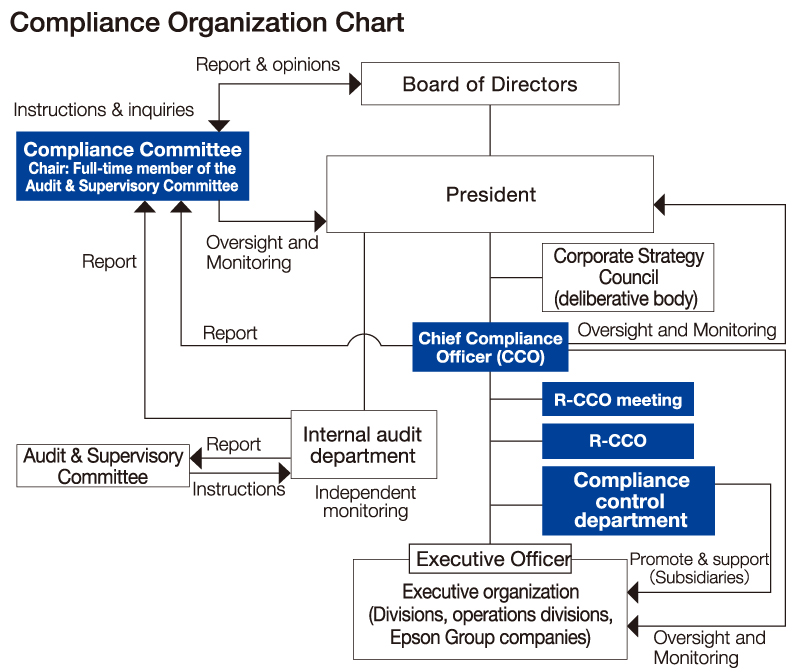
As an advisory body to the Board of Directors, the Compliance Committee is made up of all outside directors and a director who is a full-time member of the Audit & Supervisory Committee. It is chaired by the full-time member of the Audit & Supervisory Committee, and oversees and monitors business affairs by discussing important compliance activities and making reports and suggestions to the Board of Directors. The Chief Compliance Officer (CCO) oversees and monitors the execution of all compliance operations and periodically reports the state of compliance affairs to the Compliance Committee.
Under the supervision of the president, the compliance control department globally promotes and enforces compliance in cooperation with businesses and subsidiaries. It monitors compliance in general and, if necessary, makes corrections and adjustments to enhance the completeness and effectiveness of compliance activities.
Whistleblowing Systems and Reporting Channels
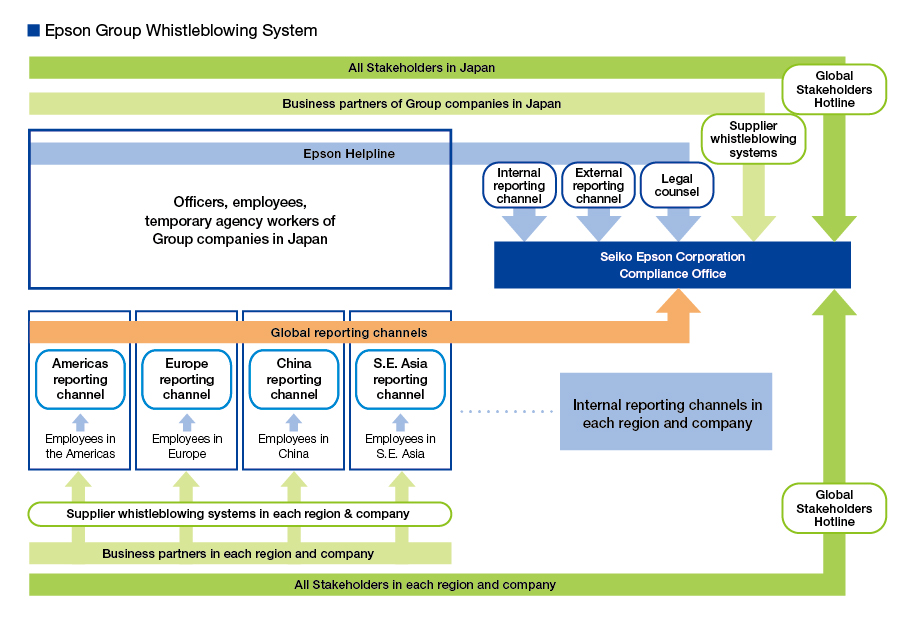
To promptly identify compliance issues that are difficult to grasp, Epson has established a reporting hotline as a means of obtaining information from officers, employees, and temporary agency workers, and has put in place a system for reporting concerning cases from this hotline. Principles of Corporate Behavior and the Epson Group Reporting System Regulations stipulate the basics that the reporting system must adhere to, such as strict management of reported information, prohibition of detrimental treatment or retaliatory actions against whistleblowers, and ensuring anonymity, and all of Seiko Epson group companies, including those in the Americas, Europe, China, and Southeast Asia, have established reporting hotlines based on these regulations.
Furthermore, the reporting channel is defined in Epson Global Code of Conduct, and we encourage officers, employees, and temporary agency workers to be aware of it and use the channel through disclosure on the intranet, Compliance Month (every October), and e-learning training.
In addition, all Epson Group companies worldwide have established supplier whistleblowing systems to receive reports from suppliers and other business partners. Seiko Epson also opened a Global Stakeholders Hotline to receive reports from all stakeholders. As with Epson's internal reporting channels, the information contained in reports is strictly protected, reprisals against whistleblowers are prohibited, and anonymity is ensured.
Suppliers and other external business partners are notified about supplier whistleblowing systems in written supplier guidelines and at supplier conferences and are encouraged to use them.
In fiscal year 2025, the group as a whole received 453 reports. These reports included allegations of violations of internal rules, misconduct, and potential illegal activities. We investigate each reported case and take corrective action if necessary. Cases and actions taken in response are regularly reported to the Board of Directors, Audit & Supervisory Committee, Compliance Committee, and the Management Strategy Council, in a manner that protects the anonymity of the people who made the reports.
Click here for details about the Supplier Whistleblowing System.
Click here for details about the Global Stakeholders Hotline (GSH).
Click here for details about the harassment counseling and reporting system.
Human rights-related inquiries and reports are handled as described below.
- Directors, employees, and temporary agency workers can use the Epson Helpline or several other reporting channels and advisory services to report or consult regarding diversity issues and so forth.
- Suppliers and other external business partners can use a supplier whistleblowing system to lodge reports.
- All stakeholders can seek engagement and remedy by filing grievances via a grievance handling platform provided by the Japan Center for Engagement and Remedy on Business and Human Rights (JaCER).
Support System in Japan
Epson has set up three types of Epson Helpline reporting channels. One type is operated internally. The second is operated by a third-party provider. And the third is operated by an external lawyer. Officers, employees, and temporary agency workers in domestic Group companies can use any type of channel to report their concerns. Instructions for using Epson Helplines are provided in a user manual posted on the company intranet. Trainings and other opportunities also cover helpline use. Reports can be lodged by e-mail or phone 24 hours a day, 365 days a year.
Seiko Epson has been proactive in developing its whistleblowing system and reporting channels, having established the first for employees and temporary agency workers ahead of the enforcement of the Whistleblower Protection Act in 2006. The company has also been responsive to changes in the Whistleblower Protection Act. For example, it has designated personnel to handle whistleblowing reports and has set up a system for receiving reports from employees and temporary agency workers up to one year after they leave the company. Seiko Epson also has an external consultant evaluate its reporting system to check for effectiveness and identify ways to improve systems in line with the latest social and regulatory trends.
In addition to Epson Helplines, Seiko Epson has set up advisory services for specific issues to provide officers, employees, and temporary agency workers with an easy way to seek advice and assistance.
Counseling and Support Services in Japan
| Harassment counseling | Management advisory service | Counseling related to overwork and long working hours |
| Career counseling | Diversity counseling | Women's health counseling |
| Employee counseling | Corruption (bribery) regulations & Competition laws advisory service | Insider trading advisory service |
Support System Outside Japan
All overseas Group companies, including in the Americas, Europe, China, and Southeast Asia, have set up reporting channels that allow officers, employees and temporary agency workers to report. Each reporting channel complies with local laws and regulations. Information contained in reports is strictly protected and reprisals against whistleblowers are prohibited. Reports may be made anonymously.
We have also introduced an Epson Executive Compliance Hotline, a global reporting system that Epson uses to directly receive compliance-related reports involving executives in subsidiaries outside Japan. The system helps us to improve the completeness and effectiveness of the reporting system in the Epson Group.
Anti-Corruption/Anti-Bribery
Epson's Principles of Corporate Behavior, specifically section 5, "Effective Governance and Compliance," stipulates the elimination of bribery, cartels, insider trading, conflict of interest, and other unethical practices, and the practice of fair, transparent, and free competition and proper trade. Recognizing any form of corruption as a significant risk to the organization's integrity and public trust, Epson is committed to combatting corruption and bribery in accordance with international frameworks such as the UN Global Compact, RBA Code of Conduct, and ISO 37001. In addition, the Epson Group Anti-Bribery and Anti-Corruption Regulation defines bribery and facilitation payments and sets forth rules prohibiting them.
A dedicated department in Seiko Epson oversees compliance across the Epson Group. Different departments implement anti-corruption and anti-bribery measures in areas such as hospitality, donations, sponsorships, agency management, and recruitment. Furthermore, a system is in place to identify and assess the Group's overall corruption risk each year, implement appropriate controls based on those risks, and report the effectiveness of the controls to the chief compliance officer (CCO).
Business Partners
We are committed to building a responsible value chain. Under Principle 7, "Coexistence and Mutual Prosperity with Business Partners," in Principles of Corporate Behavior, we require all business partners, including suppliers, sales channels, and collaborators, to adhere to high standards of ethical conduct. We require them to share the same basic stance as Epson regarding human rights, working conditions, the environment, legal compliance, ethics, information security, and quality, and we provide support as needed for improvements in these areas. Furthermore, in Anti-Bribery and Antimonopoly Act Compliance Guidelines for Business Partners and in the Epson Group Supplier Guidelines, we strongly urge our business partners to demonstrate zero tolerance of unfair practices such as bribery, cartels, insider trading, and conflicts of interest, and to act based on a stance of fair, transparent, and free competition and appropriate transactions.
Customers
In addition to informing our dealers, distributors, and service partners of the guidelines, we ask them to include compliance clauses in their business agreements whenever possible. Moreover, we are moving to check the state of compliance at our business partners.
Suppliers
The Epson Group Supplier Guidelines state that Epson does not rely on entertainment or gifts as a means of conducting business. All business partners are required to comply with the Guidelines, which includes the RBA Code of Conduct. Furthermore, they are contractually obligated to comply with the guidelines or are otherwise asked to submit a written agreement to do so. Epson also asks its suppliers to immediately report to it any violations or potential violations of the Guidelines by Epson officers or employees.
We ask our major business partners to complete an annual Detailed CSR Evaluation to assess their compliance with the Epson Supplier Code of Conduct (RBA Code of Conduct) and check for any misconduct1, including bribery, and violations of the Competition Law2. We verify the situation in accordance with the RBA Code of Conduct and audit standards. We verify that they have established policies and rules, ascertain whether they have had any compliance violations, and check whether and how any violations have been addressed. If the evaluation reveals that the response has been insufficient, we develop a corrective plan and verify that the corrective actions have been completed.
Furthermore, when evaluating new business partners at the start of a transaction, we verify that their management systems comply with bribery and competition laws.
1 RBA Code of Conduct D1: Business Integrity (The highest standards of integrity shall be upheld in all business interactions. Participants shall have a zero-tolerance policy to prohibit any and all forms of bribery, corruption, extortion and embezzlement) and D2: No Improper Advantage (Bribes or other means of obtaining undue or improper advantage shall not to be promised, offered, authorized, given, or accepted. This prohibition covers promising, offering, authorizing, giving or accepting anything of value, either directly or indirectly through a third party, in order to obtain or retain business, direct business to any person, or otherwise gain an improper advantage. Monitoring, record keeping, and enforcement procedures shall be implemented to ensure compliance with anti-corruption laws.)
2 RBA Code of Conduct D5: Fair Business, Advertising and Competition
Entertainment and Gift-giving
Illegal and unethical gifts and entertainment are prohibited.
All gift-giving and entertainment is subject to advance reporting, review, and approval.
Compliance Training
Epson considers compliance to be a fundamental principle for conducting business with confidence. The Epson Global Code of Conduct, published in 14 languages, sets forth common standards of conduct so that all our employees can make the right decisions and maintain compliance. We also have an education program under which we continue to provide our corporate officers and employees (including dispatch workers) with a variety of courses tailored to their respective positions to raise compliance awareness. The program includes online courses as well as lectures by internal and external instructors.
October is Compliance Month at Epson. During the month, Epson Group officers and employees review the Epson Way, which serves as the foundation for our business activities and as a guide to acting with the highest ethics. The Chief Compliance Officer and the heads of our business units and subsidiary companies issue compliance messages. We also provide compulsory compliance training and conduct a compliance awareness survey. Through these initiatives, we aim to raise compliance awareness and firmly establish sound operations. In addition, the awareness survey results are evaluated and analyzed for each department and subsidiary company, both domestic and overseas, and are utilized to drive organizational improvements.
Global Compliance Activities
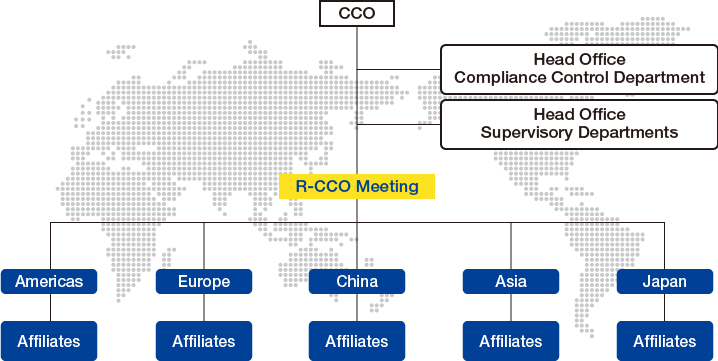
Epson Group companies operate in diverse environments. Language, culture, customs, practices, and thought differ from one region to another. To ensure that compliance activities are carried out smoothly across the Group, Epson has appointed regional Chief Compliance Officers (R-CCOs) to lead compliance activities in their respective blocs. The R-CCOs report to the Chief Compliance Officer (CCO). The blocs are organized by geographical proximity as well as similarities in language, legal regulations, and culture. This facilitates collaboration among the compliance staff at Group companies in the same bloc so that they can effectively address shared compliance issues.
Each bloc holds it own meetings. In addition, R-CCO meetings are held twice a year with the participation of the CCO and all R-CCOs. These meetings promote coordination and collaboration across the Group as venues for sharing examples and best practices that help to raise awareness.
While encouraging autonomy at the regional level, the Head Office Compliance Control Department assesses each organization and subsidiary company, sets annual targets, evaluates operations, and provides ongoing support for improvement initiatives, thereby working to minimize compliance related risks across the Group.
International Trade Control
Epson is a multinational corporation with production centers, sales centers, customers, and business partners around the world. Smooth international trade operations are essential for delivering Epson products and services to customers in a timely manner.
Meanwhile, we must observe own regulations of each country to respond the changes in international situation as well as numerous conventions and frameworks governing international trade that have been put in place to maintain international peace and security.
To maintain compliance with these and to ensure smooth trade, Epson has established comprehensive systems for reliable trade management for entire Epson Group. As a result, Epson group companies have many certifications around the world as companies that complies with the systems and programs established by the authorities of each county in Japan, North America, Latin America, Europe, China, Asia, etc., especially in areas of security trade control and security management that strict operations are required.
These contribute to an efficient and speedy supply chain for the entire group, such as simplification of import/export procedures and cost reduction.
Tax Compliance
Epson seeks to fulfill its corporate social responsibility by paying appropriate taxes in compliance with the spirit as well as the letter of the tax laws and regulations in the countries and regions where it operates. In accordance with this basic policy on taxes, we are taking the actions below to maintain and improve tax compliance.
1.Tax governance
- The Board of Directors is responsible for overseeing tax risk, and Epson's Chief Financial Officer is the responsible official of Group tax affairs. The group that is in charge of tax affairs reports and manages taxes is under the supervision of the Chief Financial Officer.
- Epson considers tax risk to be an important risk, and regularly reports such risks to the board of directors and the Corporate Strategy Council, which is composed of directors of the company.
- Employees are trained in the tax-related regulations and business process standards that Epson has established to ensure that it properly fulfills its tax obligations. We conduct periodic internal tax audits and report the findings to top management and to the Audit & Supervisory Committee.
2.Monitoring tax affairs
- We appropriately respond in a timely manner to changes in local tax systems and taxation trends through regular reporting among the group that is in charge of tax affairs and Epson's local subsidiaries.
- We enlist the support of tax accounting firms and other external experts for advice on taxes and for tax support in each country and region.
3.Tax planning and Tax avoidance
- Around the globe, we strive to effectively use preferential taxation systems where possible in our normal business activities to ensure a suitable tax burden.
- We do not transfer value created to low tax jurisdictions, and do not use tax structures intended for tax avoidance without the spirit of the law.
4.Dealing with uncertainty
- Tax risk uncertainty is expected to increase as countries and regions around the globe strengthen their tax reporting obligations, tax audits, and tax enforcement. Epson controls tax risks by identifying situations that could potentially pose serious tax risks.
5.Transfer pricing taxation
- Epson complies with local tax laws and OECD guidelines to control transfer pricing tax risks. We have established transfer pricing guidelines for the Epson Group to help ensure appropriate transfer pricing transactions. In line with these transfer pricing guidelines, we control the profitability range of our global subsidiaries to ensure that transactions are made at arm's length.
- We use an advance pricing arrangement (APA) for transactions with subsidiaries in high-risk countries.
6.Anti-tax haven rules (also known as Japanese Controlled Foreign Company rules, or "CFC")
- Epson sets up foreign subsidiaries to carry out its ordinary business activities, but does not do so in "tax haven" jurisdictions to avoid taxes. When anti-tax haven rules apply, Epson properly files and pays taxes.
7.Relationships with tax authorities
- Epson strives to work in good faith with tax authorities and to maintain and improve good tax corporate governance.
Social Media UseSocial Media Use