


Water Resources Management
Water is closely linked to other environmental factors, including climate change. Epson recognizes its dependence on water resources and acknowledges that the sustainability of water resources is critical for business continuity. Therefore, Epson proceed water management activities at the group level and at each site.
Water Resources (Performance)
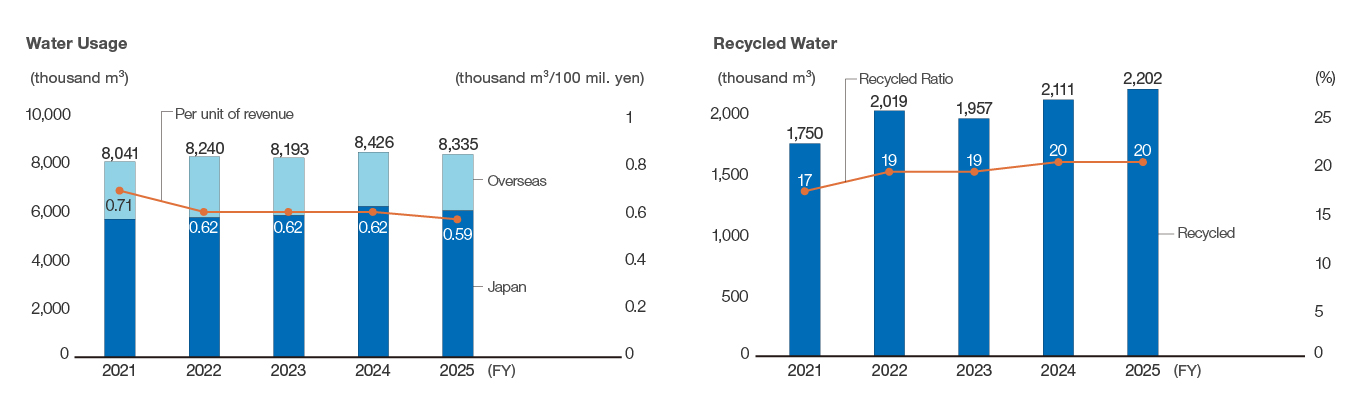
Epson has set group-wide goals for water usage efficiency and is working to reduce water consumption through the introduction of water-saving equipment and improving the recycling rate of industrial water. Additionally, water withdrawal at each site is tracked by source, such as municipal water and groundwater. The company places importance not only on managing the water used in manufacturing processes but also on ensuring that all employees have access to safe drinking water and sanitary water environments. At some sites, improvements such as the introduction of water-saving toilets, as well as awareness-raising activities for employees on water conservation and pollution prevention, are being implemented.
Moreover, water management plans have been developed at 22 sites. These plans set goals for reducing water consumption and increasing water recycling rates, promoting the proper management of water resources at each site.
FY2025 Overview
Group Goal: 7.3 thousand m³ per billion yen (1% reduction in water intake per unit of annual revenue compared to the reference value)
Result: 5.9 thousand m³ per billion yen (20% reduction from the reference value)
Reference value: 7.4 thousand m³ per billion yen (average for FY2017 to FY2022)
FY2026 Water Intake Intensity Target
Group goal: 38.3 thousand m³/100 million yen (1% reduction from the previous year in the volume of water withdrawn per volume of annual raw materials used)
Related Information
Addressing Water Related Risk
Epson analyzes the risks and opportunities associated with the Epson Group's natural capital, including water-related risks, in accordance with the LEAP approach1 recommended by the Taskforce on Nature-related Financial Disclosures (TNFD).
Our analyses have shown that two of the eleven priority areas identified based on the TNFD are located in Southeast Asia, an area of water stress2. In FY2025, these sites used approximately 320 thousand m³ of water per year. To understand the local situation, we conducted interviews and assessed the local water risk situation. We did not observe any major constraints on water supply or tightening of regulations at the sites in question, and we believe that the impact on business continuity is limited.
Going forward, we will continue to monitor water-related risks and implement necessary risk mitigation measures as part of our response to natural capital and biodiversity-related risks and opportunities based on the TNFD.
1 An integrated approach for assessing nature-related dependencies and impacts, risks, and opportunities.
2 Sites assessed as having "extremely high" water stress in the Aqueduct database.