Promoting Sustainability Management
Epson has been helping to solve societal issues through its products and services. Going forward, we at Epson will continue to work toward realizing a sustainable society and enhancing corporate value under our ENGINEERED FUTURE 2035 long-term vision. Together with our customers and partners, we will strive to create both social and economic value through co-creation, contributing to a more sustainable future.
- Strengthening sustainability management
- Internationally Recognized Principles Epson Respects
- Promotion Organization
Strengthening sustainability management
In formulating the ENGINEERED FUTURE 2035 Long-Term Vision, we examined the social environment
from various angles and recognized that companies are affected by significant changes, including
decarbonization, tightening energy and resource constraints, the rapid advance of the AI and data
society, worsening labor shortages, population growth and economic growth mainly in emerging
countries, geopolitical risks, and tighter regulations. These changes bring new constraints and risks to
corporate activities, while also presenting major opportunities for the transformation of social and
industrial structures themselves.
In this environment, what is required of companies is management that balances solving societal issues
with sustainable growth, not merely the pursuit of short-term profit. In ENGINEERED FUTURE 2035, we
aim to contribute to the sustainable development of society and industry based on our technologies
and philosophy of efficient, compact, and precise. Epson will create value originating in societal issues,
evolve technology, and implement that value in society to achieve the simultaneous creation of social
value and economic value. We will enhance our corporate value over the medium to long term by
improving profitability and capital efficiency. Our environmental initiatives will balance solving customers’
issues with creating business opportunities by providing products and services that contribute to
reducing environmental impacts through energy-saving and resource conservation technologies.
To sustainably realize value creation, it is essential that we strengthen not only the business itself but
also the management foundation that supports it. Positioning human capital as one of our sources of
value creation, Epson is working to develop a global organizational and human resources base, while
also developing leadership talent that can envision and execute even in highly uncertain environments,
strengthening engineering talent that connects technology to real-world implementation, and
promoting diversity. Along with strengthening intellectual capital, we are advancing the sophistication
of the management foundation that supports value creation through ESG (environmental, social, and
governance) initiatives. Epson has also been advancing initiatives such as transitioning 100% of the
electricity used across its global operations to renewable energy and addressing environmental and
human rights issues across the supply chain, through activities including those of the Responsible
Business Alliance (RBA). Toward the realization of ENGINEERED FUTURE 2035, the Group as a whole
is advancing initiatives on key issues including promotion of decarbonization, utilization of renewable
energy, strengthening of supply chain resilience, respect for human rights, compliance, and
information security.
Based on this approach, Epson analyzes the risks and opportunities brought about by changes in the
social environment and identifies its materialities as key issues for creating value through its business.
Epson has also rebuilt its value creation process starting from our materialities and has set initiative
themes and KPIs. In line with this review of our value creation process, we also reorganized KPIs
related to our management foundation, a non-financial area, and improved KPIs related to human
capital and intellectual capital with a stronger focus on linkage to and contribution to business growth.
We will work to realize ENGINEERED FUTURE 2035 while continuously managing and improving the
status of our creation of social value and economic value.
Internationally Recognized Principles Epson Respects
Epson will fulfill its social responsibilities through independent action and continuous improvement in accordance with its Principles of Corporate Behavior, based on its purpose, "Our philosophy of efficient, compact and precise innovation enriches lives and helps create a better world," its Management Philosophy, and the underlying spirit of "Sincerity and Effort" and "Creativity and Challenge" that the company has valued since its founding.
Epson complies with the laws and regulations in the countries and regions in which it operates and aligns its Principles of Corporate Behavior with the internationally recognized principles listed below to ensure that its conduct meets societal expectations.
Internationally Recognized Principles
- The Ten Principles of the United Nations Global Compact
- The Sustainable Development Goals (SDGs)
- OECD Guidelines for Multinational Enterprises
- Keidanren Charter of Corporate Behavior
- ILO Core Labor Standards
- RBA Code of Conduct
- ISO 26000
- United Nations Guiding Principles on Business and Human Rights
Promotion Organization
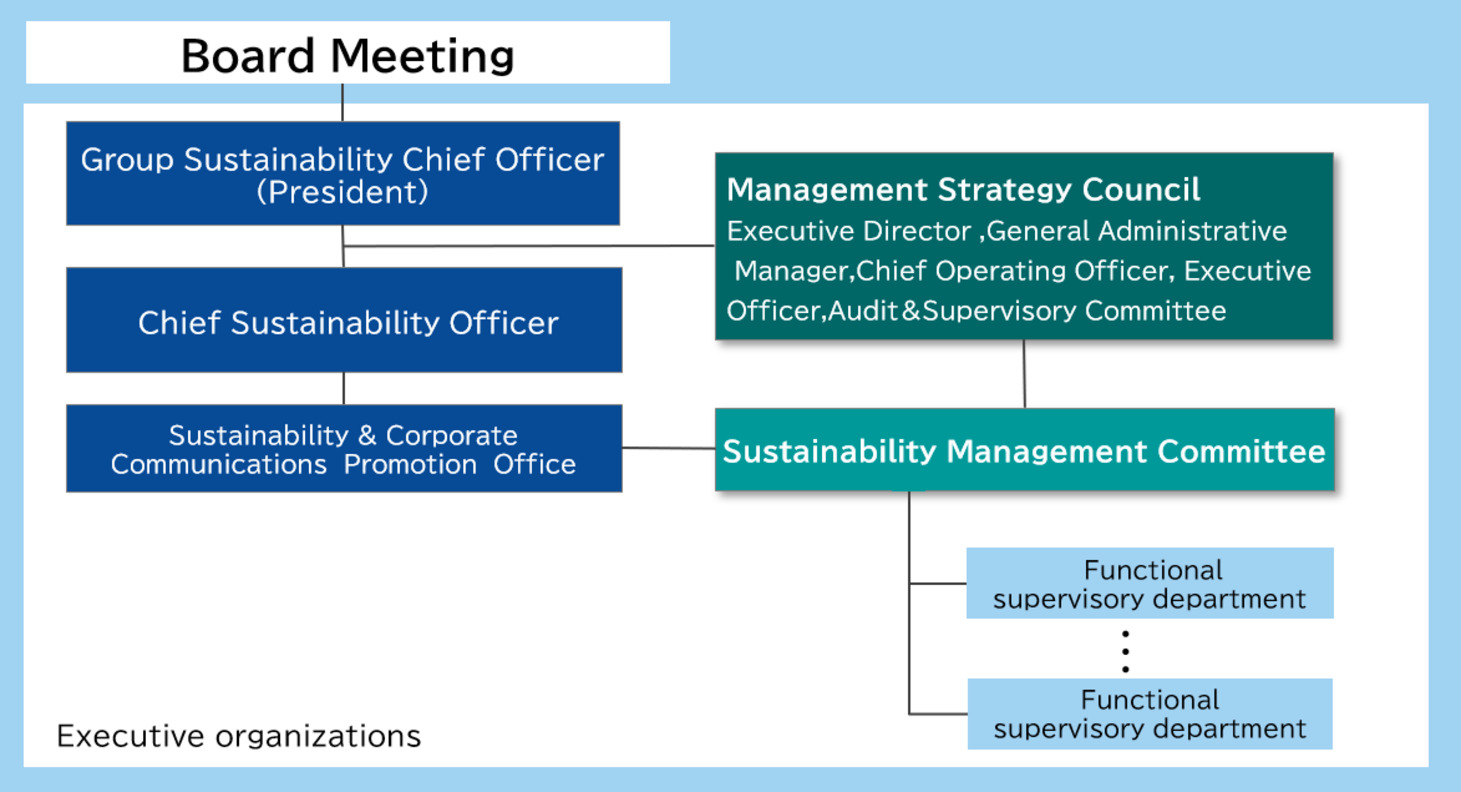
Epson's Sustainability & Corporate Communications Promotion Office, established directly under the
President and headed by an executive officer, is responsible for sustainability activities across the
Group. We also established the Corporate Strategy Council as an advisory body to the President. The
Council comprises members of executive management such as general administrative managers and
chief operating officers, as well as outside directors and Audit & Supervisory Committee members.
Members of the Council formulate medium- to long-term, Group-wide sustainability strategies based on
analyses of social trends, review the progress of initiatives, and address key issues.
As a subordinate organization under the Corporate Strategy Council, we established the Sustainability
Management Committee to engage in discussion and examination of specialized matters related to
sustainability activities. The Sustainability & Corporate Communications Promotion Office serves as the
administrative office for the Sustainability Management Committee. It regularly reports sustainabilityrelated
affairs to the Board of Directors and operates under its oversight.
Action Items
Management Strategy Council: Sustainability Agenda & Reports
| Fiscal Year (Meetings Held) | Main Topic of Discussion |
|---|---|
| FY2025 (6 times) |
・Performance in FY2024 versus the FY2025 KPI for the Key Sustainability Topics ・ Evaluation results of Taskforce on Nature-related Financial Disclosures (TNFD) and disclosure in FY25 ・ Responding to sustainability disclosure standards (SSBJ/CSRD, etc.) ・ Human rights seminar ・ RBA code compliance ・ Procurement practices compliance. |
Social Media UseSocial Media Use