


Vision
Environmental Policy
The products and services Epson provides can realize their full value only when the environment is
preserved and people's lives remain stable. Accordingly, we view efforts to address environmental
issues, including climate change, as both a corporate responsibility and a fundamental prerequisite for
the sustainable growth of our business.
Since founding, Epson has cultivated our efficient, compact and precise technologies and philosophy. Products and services developed from these strengths have contributed to reducing
environmental impacts throughout society in diverse ways. By creating customer value and expanding
business opportunities, we also deliver greater environmental value. We will simultaneously achieve
business growth and create environmental value across the entire value chain.
To sustain this value creation, we also continuously work to reduce the environmental impacts of our
business activities as a fundamental responsibility of a manufacturer. In Environmental Vision 2050, we
established the goal of becoming carbon negative and underground resource1 free by 2050. To achieve
this vision, we are implementing a medium-term environmental action plan.
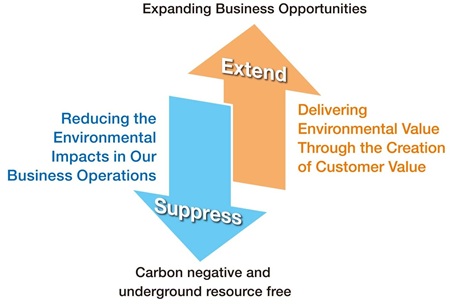
Epson's environmental policy is built on two pillars: delivering environmental value through customer
value creation and reducing environmental impacts from our own business activities.
1 Non-renewable resources such as oil and metals.
Environmental Vision 2050
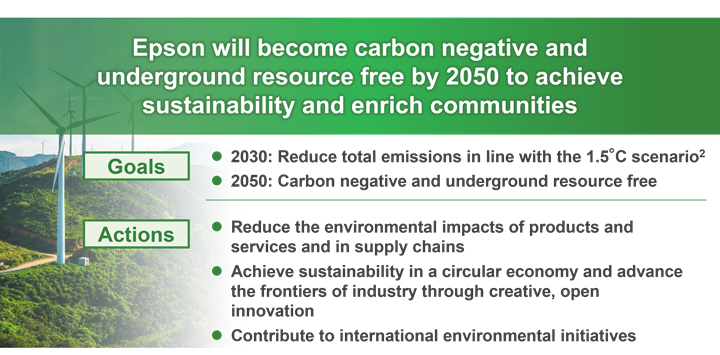
In March 2021, Epson formulated its Environmental Vision 2050, demonstrating its strong commitment to addressing the major socialchallenges of decarbonization and closing resource loop. We are working to reduce environmental impact of our business in order toachieve carbon negative and underground resource1 free.
1 Non-renewable resources such as oil and metals.
2 Target for reducing greenhouse gas emissions aligned with the criteria under the Science Based Targets initiative (SBTi).
Roadmap
Epson is implementing actions set forth in our mid-term environmental action plans to achieve carbon negative and underground resource free by 2050.
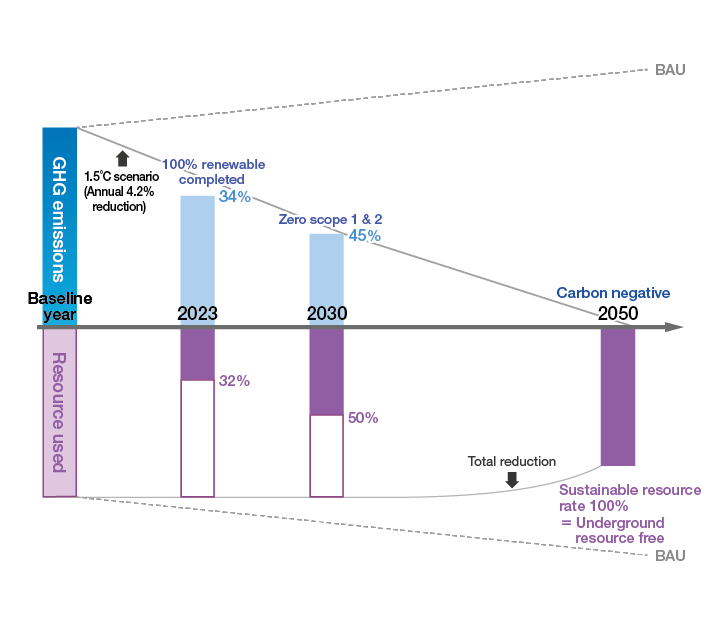
Targets and main strategic actions by category in the Mid-Range Environmental Action Plan
| Decarbonization |
2030 Target ・Zero Scope 1&2 emissions1 ・55% reduction in total Scope 1, 2, and 3 emissions (compared to FY2017 levels) Main strategic action ・Scope 1 (Fuels): Electrification & conversion to decarbonized fuels ・Scope 2 (Electricity): Switch to renewable electricity & expand local and in-house power generation |
|---|---|
| Closed Resource Loop |
2030 Target ・50% sustainable resource rate Main strategic action ・Use sustainable resources for main materials (plastic & metal) |
| Multifaceted Actions |
Main strategic action ・Reduce product size, weight & replacement parts ・Reduce product energy use ・Resell returned products, refurbish used products, refill ・Establish long service life business model ・Engage suppliers on renewable electricity & recycled materials ・Minimize production losses, reduce GHGs |
1 Prioritize reducing absolute scopes 1 and 2 emissions by 90% compared to 2017. All residual emissions will then be neutralized.