Delivering Environmental Value through Customer Value Creation
Epson will deliver environmental value across the value chain by creating customer value and expanding business opportunities through our efficient, compact and precise technologies and philosophy.
Specifically, we are creating value by reducing environmental impact across the market through the transition from conventional technologies and creating environmental value through industrial transformation.
- Reducing Environmental Impact Across the Market through the Transition from Conventional Technologies
- Creating Environmental Value Through Industrial Transformation
- Other Case Studies
Reducing Environmental Impact Across the Market Through the Transition from Conventional Technologies
By encouraging the transition to Epson’s lower-impact solutions in place of conventional products and services, we help cut energy consumption and resource use, contributing to a lower environmental impact across the market as a whole.
High-capacity Ink Tank Printer
High-capacity ink tank printers, which Epson introduced in 2010, significantly reduce the frequency of
ink replacement compared with conventional ink cartridge printers. By reducing the use of consumables
and packaging materials, environmental impacts across the product life cycle, including reduced GHG emissions from material production, transportation, and disposal.
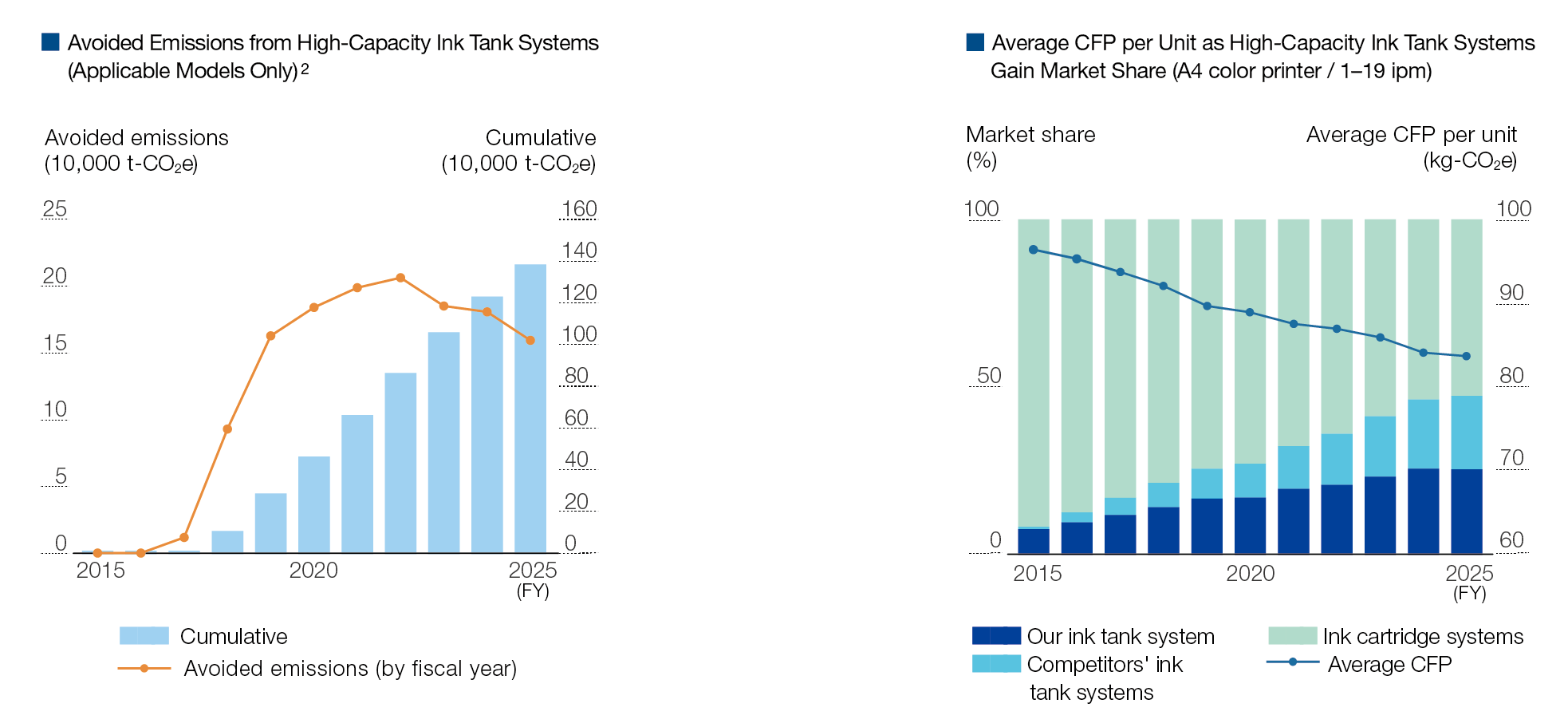
Based on the replacement of ink cartridge printers with high-capacity ink tank printers, we calculated
FY2025 avoided emissions1,of approximately 160,000 t-CO2e. The high-capacity ink tank system pioneered by Epson has driven market transformation and become firmly established as a major option for customers. As a result, annual avoided emissions are beginning to level off, reflecting the steady
progress of this market transformation. Cumulative avoided emissions from FY2010 to FY2025 reached
approximately 1.39 million t-CO2e2, demonstrating our contribution to reducing environmental impacts over the long term.
Based on these results, we will continue aiming for further environmental impact reductions across
society by capturing and expanding business opportunities and by reducing environmental impacts.
1 Using market data from IDC's Worldwide Quarterly Hardcopy Peripherals Tracker and Epson sales
data, we estimated the average alternative purchasing scenario that customers would likely have
chosen in the absence of Epson's high-capacity ink tank printers.
This scenario reflects the market
share composition of high-capacity ink tank printers and ink cartridge printers. Avoided emissions were
then calculated by multiplying the estimated number of printer units corresponding to ink cartridge
printers in this scenario by the difference in lifetime CO2 emissions between the two printer types.
2 Calculated based on approximately 70 million units for which comparable ink cartridge printer models were available, out of our cumulative worldwide sales of 119 million units from FY2015 to FY2025.
A3 Color Inkjet Printers
Epson's inkjet printers require less limited lifetime parts in addition to the low power consumption through Heat-Free Technology ,which uses no heat to eject ink. By promoting the replacement of laser printers, thereby reducing the environmental impactassociated with printing and contributing to the environmental impact reduction of society. To ensure that the information is fair tocustomers, the calculation logic was developed based on the guidelines published by the World Business Council for SustainableDevelopment (WBCSD) and confirmed by a third-party organization. avoided emissions COby replacing laser printers with Epson A3color inkjet printers in FY2025 will be 9.0k t-CO2e3.
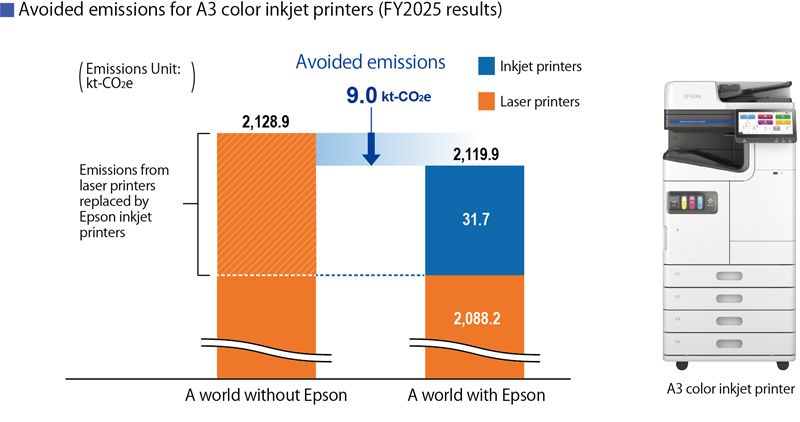
3 The value obtained by multiplying the difference between the weighted average of the published lifetime CO2 emissions of major laser printers in the global market and the lifetime CO2 emissions of Epson's A3 color inkjet printer by the number of Epson A3 color inkjet printer units sold in the fiscal year, based on the calculation method confirmed by Mizuho Research & Technologies Co., Ltd.
Creating Environmental Value Through Industrial Transformation
We create new environmental value through innovations that drive industrial transformation. By putting Epson’s technologies into practice to transform manufacturing processes and enhance product performance, we help reduce energy consumption and resource use.
Inkjet Technology for Energy and Resource Efficiency in Production Equipment
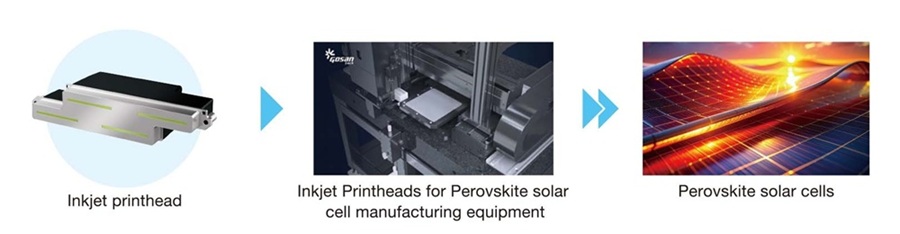
In the manufacture of perovskite solar cells using inkjet technology, Epson's additive manufacturing technology enables materials to be deposited precisely where and in the amounts needed. This minimizes material loss and reduces energy consumption through low-temperature, non-vacuum processes. As lightweight solar cells with fewer installation constraints, perovskite solar cells can also accelerate the adoption of renewable energy during the use phase, contributing to the reduction of GHG emissions across society.
Related Information
Microdevices for Energy Efficiency in Data Centers
As the proliferation of AI drives rapid growth in data center power demand, Epson's high-frequency crystal oscillators help improveenergy efficiency. Leveraging our proprietary crystal and semiconductor technologies, these devices offer high precision, low powerconsumption, and miniaturization. Their accurate timing control supports faster and more efficient communications betweendevices, helping to reduce power consumption at data centers.
Related Information
Metal Powder Technology for Metal Resource Circulation
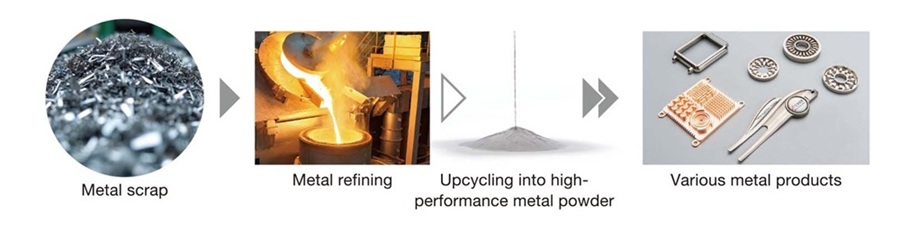
Epson Atmix upcycles off-specification powders generated during metal powder production, as well as other metal scrap, into high-performance metal powders using its proprietary powder metallurgy technology. Amorphous soft magnetic powders producedthrough Epson Atmix's unique SWAP® process offer excellent magnetic properties that help reduce power loss and improve energyefficiency. By replacing virgin raw materials with recycled materials, Epson Atmix reduces natural resource consumption and GHGemissions, thereby contributing to resource circulation and the realization of a circular economy.
Related Information
Other Case Studies
Explore additional examples of the environmental value Epson delivers across a wide range of customer use cases.
Related Information
Social Media UseSocial Media Use