Case study
Explore examples of the environmental value Epson delivers across a wide range of customer use cases.
Office
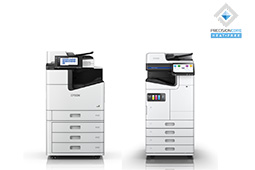
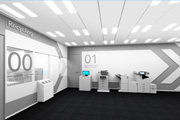
Balancing printing performance with low power consumption to reduce the environmental impact of offices
Epson's business inkjet printers use our original Heat-Free Technology to eject ink without heat, achieving outstanding low power consumption. With a wide range of models from slow to high-speed, we offer the ideal low-power printer for customers in various usage environments, helping to reduce the environmental impact of offices.
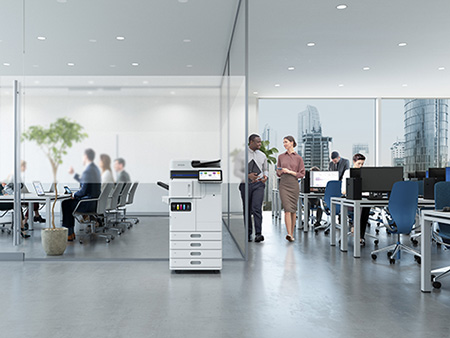
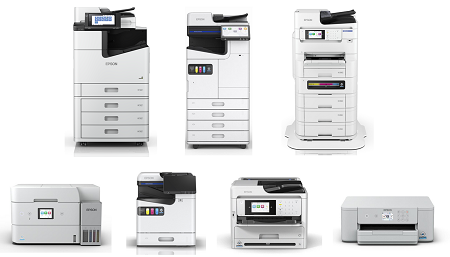
Suggestions for office environmental measures
As awareness of environmental issues increases, many offices are taking steps to reduce electricity consumption, for example, by adjusting the air conditioning temperature settings or switching to LED lighting. In fact, printers and MFPs account for about 10% of electricity consumption in the office.
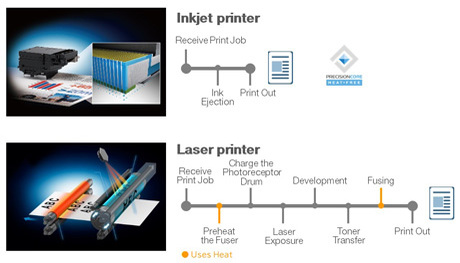
Epson inkjet printers consume significantly less electricity than laser printers during printing because ink droplets are ejected by the movement of piezoelectric elements that contract when a tiny voltage is applied, whereas laser printers require a high-temperature heating process to fuse toner to paper.
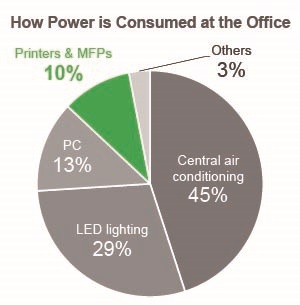
1 Epson survey. Based on a commissioned study by SOMPO Risk Management & Health Care Inc. (March 2018).
Electricity consumption over 1 week
The TEC1 of Epson business inkjet printers and laser printers from other companies is compared in the graph below2 for each speed category. Epson business inkjet printers achieve excellent low power consumption across all speed categories.
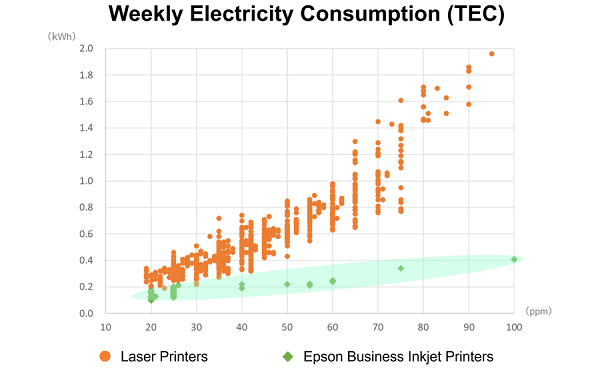
1 TEC (Typical Electricity Consumption) is the weekly electricity consumption (5 days of operation and sleep/off + 2 days of sleep/off) assumed for standard printer usage in the office.
2 A3/A4 monochrome and color devices registered on energystar.go.jp as of June 16, 2025. The TEC value of Epson's business inkjet printers includes non-registered products and is based on the test method of the ENERGY STAR® Program Requirements for Imaging Equipment. Actual power consumption may vary depending on customer usage.
Reduction of annual power consumption
Linehead inkjet MFPs with PrecisionCore Heat-Free Technology consume far less power than laser printers during the printing process, helping to keep office running costs down. An independent performance comparison found that the average annual power consumption of the LM-C5000 is about 80% lower than that of competing color laser MFPs.
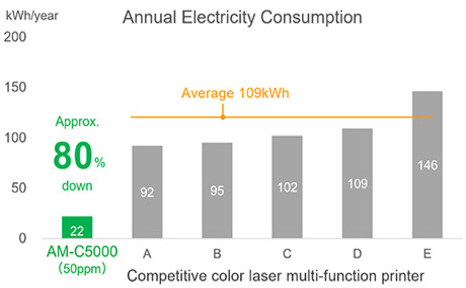
* The annual power consumption graph is based on test data from Keypoint Intelligence, commissioned by Epson. The LM-C5000 was tested in May 2023 for European models. Epson selected the comparison devices from the top five vendors in the color laser MFPs with 41-50 pages per minute class 3. Using the default settings of each device, Keypoint Intelligence's standard energy consumption testing method was used to test the devices. The weekday printing workload was calculated based on 2x4 hours of printing + 16 hours in sleep/standby mode, and weekend energy usage was calculated based on 48 hours in sleep/standby mode. A total of 69 pages of test patterns (DOC, XLS, PPT, HTML, PDF, and Outlook email) were printed six times during each of the four-hour printing periods.
3 Source: IDC’s Worldwide Quarterly Hardcopy Peripherals Tracker 2023Q1, Units Share by Company
Recognized with the Agency for Natural Resources and Energy Commissioner's Award at the 2023 Energy Conservation Grand Prize
Epson received the Agency for Natural Resources and Energy Commissioner's Award in the Product & Business Model Category of the 2023 Energy Conservation Grand Prize organized by the Energy Conservation Center, Japan. The LM series linehead inkjet MFPs 4 were recognized for their energy-saving performance, including reduced power consumption in sleep and operation modes enabled by the introduction of a new circuit unit.
4 WorkForce Enterprise LM-C6000/C5000/C4000
Seiko Epson received the Agency for Natural Resources and Energy Commissioner's Award (Product & Business Model Category) for their new MFPs 4 under the fiscal 2023 Grand Prize for Excellence in Energy Efficiency and Conservation awards program organized by the Energy Conservation Center, Japan. Among other things, the new MFPs were recognized for their higher energy efficiency compared with the previous models for the reason such as the introduction a new circuit unit reduces power consumption in sleep mode and during operation. (December 2023)
4 WorkForce Enterprise LM-C6000/C5000/C4000 linehead inkjet multifunction printers.

Find product information for linehead inkjet MFPs here.
Eco-conscious office with inkjet printers and dry-process paper fabrication systems
Epson is proposing an eco-conscious office that contributes to the environment.
By combining inkjet printers that reduce electricity, waste, and printing costs with Epson's proprietary heat-free inkjet technology and a dry process office papermaking system that conserves water resources and makes effective use of forest resources, we can achieve effective results. This solution provides customer value by recycling paper resources in the office while taking advantage of the convenience of paper, reducing costs, and enhancing security.
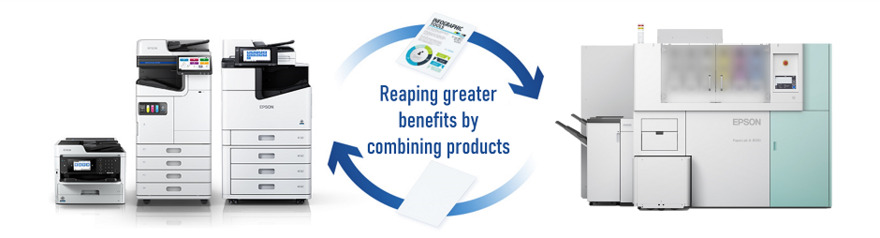
Epson has installed 19 PaperLabs at its 9 main sites in Japan. The aim is to reduce the amount of paper purchased by recycling paper used on-site (locally produced, locally consumed).
By publicizing the way we operate and our paper recycling results, we can give customers a concrete idea of the environmental benefits they can achieve by working with us to further improve their own environmental performance.
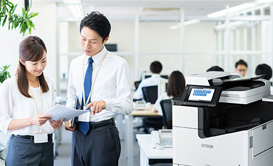
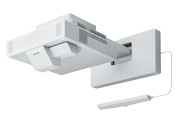
Improving Meeting Productivity with Interactive Communication
They increase the productivity of interactive meetings and the effectiveness of presentations, while also helping to reduce the environmental impact at the customer's site.

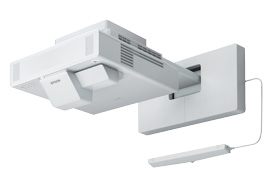
EB-1485FT
Reducing environmental impact through remote conferencing
It features "multi-site interactive functionality" and "dual-screen display functionality."
By using this system in conjunction with existing video conferencing systems, it enables meetings with a sense of presence similar to face-to-face meetings, thus reducing the need for travel. This contributes to reducing environmental impact.
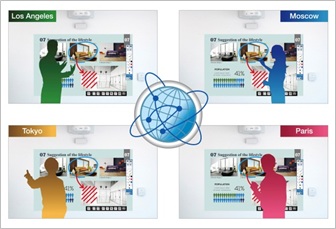
Multi-location interactive
- Share your PC screen with up to four locations.
- Both parties can write on the screen and save the data to their PCs.
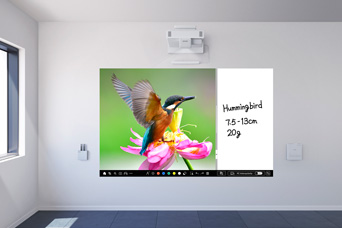
2-way split screen
- Share whiteboards and PC screens to hold virtual meetings that feel real.
- Clearly display two images on a 100-inch screen.
As a whiteboard
The interactive projector combines the functions of a projector and a typical whiteboard (copyboard, electronic blackboard) in a single unit, saving both resources and installation space. It connects directly to a projector and enables users to annotate up to 20 projected data sets or images with a digital pen. Data can be saved as is or sent directly to a projector, increasing meeting productivity while minimizing paper use.

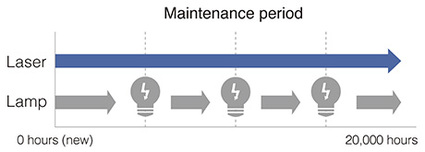
Reliability and ease of use thanks to the laser light source
The light source is extremely reliable, eliminating worries about lamp burnout during important meetings.
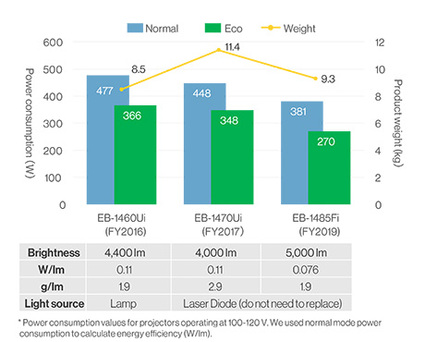
Energy and Resource Saving
In the product life cycle, the CO 2 emissions of projectors are highest during the customer use stage.
We aim to improve product performance while reducing electricity and resource consumption during use.
Home
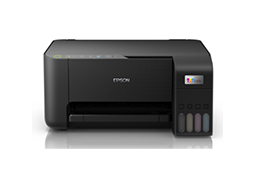
Achieving reduced environmental impact through high-capacity ink tank system.
Inkjet printers with a high-capacity ink tank system are refilled from bottles. Compared to traditional cartridge-based systems, the high capacity of ink bottles reduces the frequency of consumable replacements for the same amount of ink used, thereby minimizing the resources used for consumables, including their packaging.
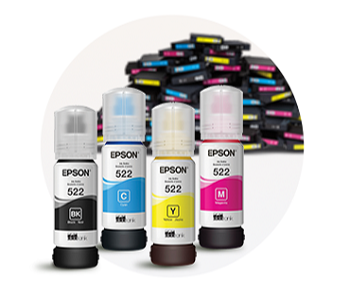
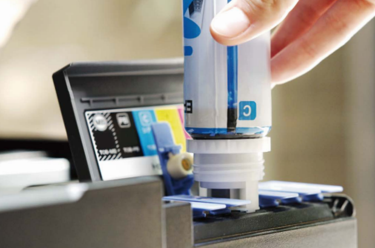
Comparison of environmental impact with cartridge systems
A comparison of the environmental impacts of the ET-2910 with high-capacity ink tank system and the XP-2200 with ink cartridge system1 shows that for printing 9,000 pages2, the consumables used are reduced from about 95.1 ink cartridges to about 5.5 ink bottles, resulting in a 95% reduction in the environmental impact of consumables. This contributes to a reduction in the overall environmental impact over the lifecycle of the high-capacity ink tank system printer.
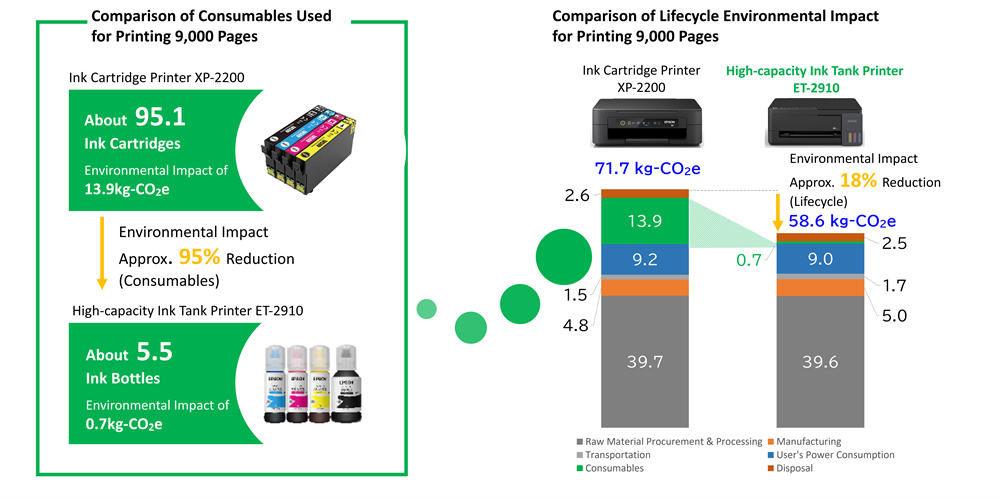
1 Based on the calculation methodology of Mizuho Research & Technologies, Ltd., this is calculated using data from each stage of the product lifecycle (raw materials procurement/processing, manufacturing, transportation, use, disposal) and is based on Epson's evaluation conditions. It may vary depending on the customer's usage and the product.
Please note that this calculation does not take into account the effect of paper. The products used for comparison are models sold exclusively overseas.
2 Based on TEC standards, this is the number of pages printed over 3 years at a product print speed of 10 ipm.
Manufacturing sites
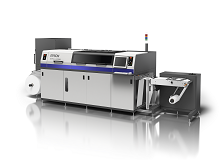
Label Printing Technology Shifts from Analog to Digital
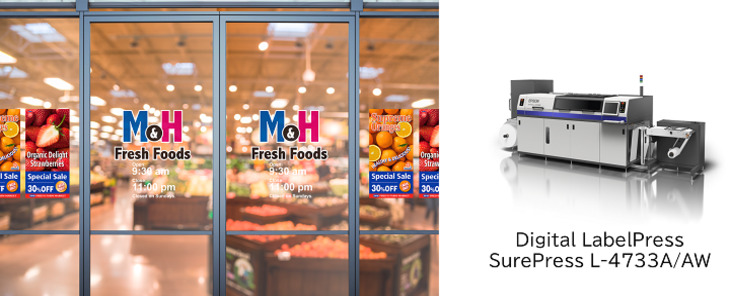
The trend toward short-run printing of a wide variety of packages and labels has reached the packaging and labeling industries, and companies are looking for efficient solutions that can accommodate this trend. Epson's digital inkjet label presses provide a new label printing workflow that meets the needs of our customers.
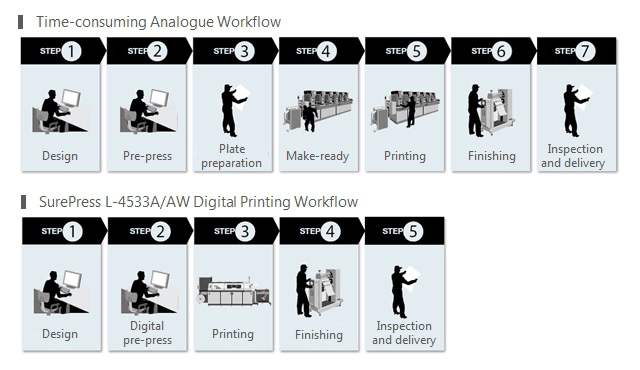
Efficient and low-environmental impact label printing process
The analog printing process does not require printing plates or pre-press processes, and it saves resources because it does not consume developer or film. It also saves paper and ink because it can produce stable output without the need for test prints. This makes the printing process more efficient and reduces environmental impact.
Water-based Ink That Reduces Work
SurePress AQ ink T4, a water-based pigment ink used in Epson's digital label presses, has excellent adhesion and does not require pre-coating of the label stock.
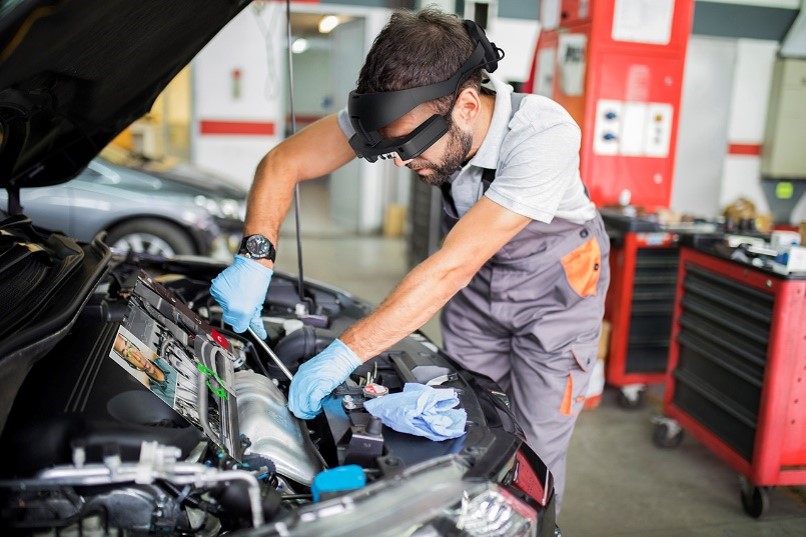
Reducing environmental impact through remote work support
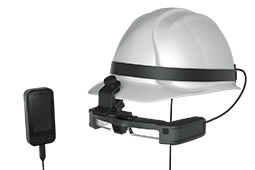
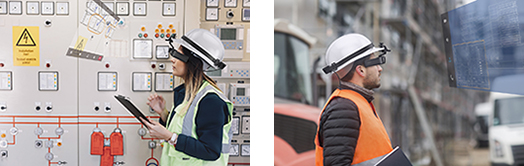
Epson's smart headsets with a see-through, dual-eye display and hands-free operation digitize paper manuals and work instructions, enabling workers to perform tasks with both hands, thereby increasing operational efficiency and work quality. In industrial applications such as maintenance work, managers can provide remote instructions and support to workers.
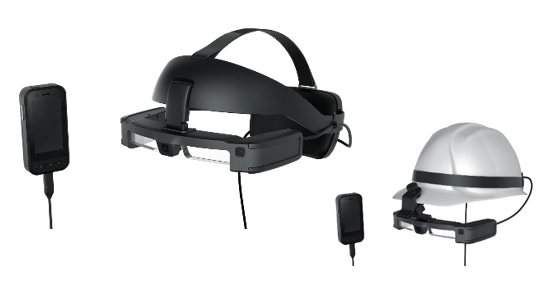
1 Helmet is not included.
Remote assistance
The smart headsets are equipped with an 8-megapixel high-resolution camera at the center position. They enable workers to receive instructions for complex tasks by sharing images and audio from the worker's point of view in real time.
In addition to safely increasing work efficiency and contributing to business efficiency, these smart headsets enable remote technical guidance by experts, thereby reducing the environmental impact associated with the movement of people.

Advantages of Using a Smart Glasses System
- No need to print paper manuals and instructions (digitalization)
- Increase work efficiency with hands-free operation
- Both eyes are transparent, so the user can see the surroundings while working or viewing projected images, ensuring safety.
- Share video and audio with workers in remote locations to provide effective assistance
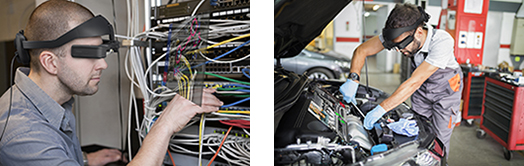
Usage Scenes
Used for work where a cap is worn and where a cap is not worn
- Infrastructure business (server rooms)
- Manufacturing (assembly of office automation equipment, consumer electronics, vehicles, etc.)
- Maintenance (large equipment such as aircraft, semiconductor manufacturing equipment)
- Agriculture (technology transfer from experts to young farmers)
Work environments where helmets are required
- Infrastructure business (electricity, gas, water)
- Manufacturing (construction machinery, steel, robotics)
- Construction and public business (building construction, excavation, bridge construction)
"Making small things small": micro injection molding machine that combines economic efficiency and environmental performance.
"The smaller the part, the greater the waste of materials and energy in the manufacturing process."
Epson's micro injection molding machines (the AE-M3 and AE-M10) are a new solution for this customer issue.
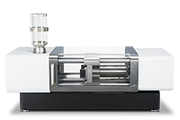
These machines are ideal for molding small, precision parts, thanks to Epson's proprietary disk drive system, which dramatically reduces machine size and achieves outstanding energy efficiency.
The standard hot runner system minimizes waste and increases the efficient use of input resources.
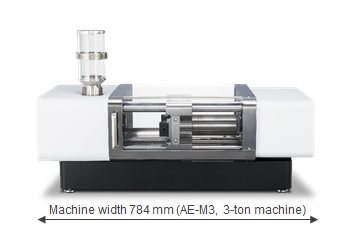
AE-M3/M10
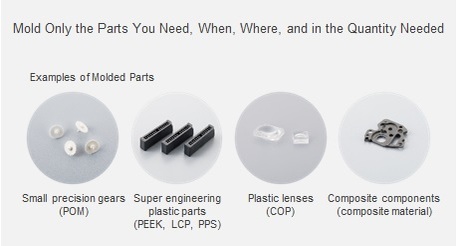
Use a small amount of energy to precisely inject and quickly mold without waste
Injection molding machines melt plastic materials with heat (plasticization) and precisely inject the molten material into a mold. The material is then cooled and solidified in the mold before being removed as a molded product.
Epson's micro injection molding machines employ a proprietary disk drive system for the plasticization and injection mechanism. This system precisely injects plasticized material with a small amount of energy. The short plasticization path also helps to reduce thermal damage to the material, which can affect molding quality.
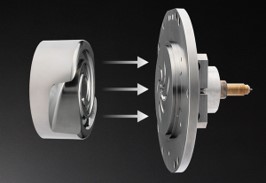
The standard hot runner system minimizes waste from runners and other parts in the molding process. It also shortens the cooling time after mold clamping, which reduces molding time (cycle time) and increases productivity.
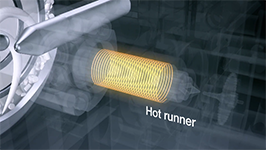
Click here for a video of injection molding.
* The video above is provided using the service of YouTube™. YouTube™ is a trademark of Google Inc.
Reducing CO2 Emissions by Saving Energy, Space, and Reducing Waste Plastic
Epson's micro injection molding machine has a much smaller environmental impact than a typical 30-ton molding machine. In addition to its compact size and energy-saving features, the Epson machine reduces the environmental impact of the molding process by minimizing waste from runners and other byproducts.
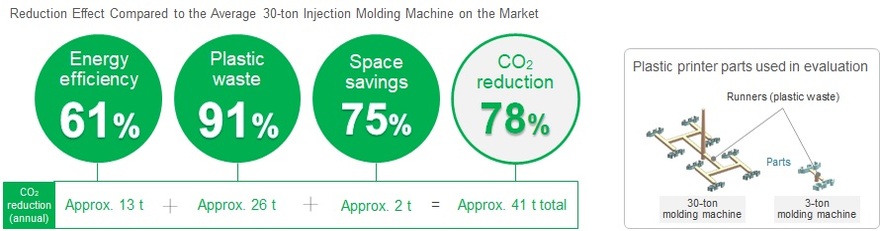
* This evaluation is based on a comparison of producing 500,000 Epson printer parts per month, with the calculation methodology confirmed by Mizuho Research & Technologies, Ltd. The comparison is based on Epson's AE-M3 (3-ton molding machine) with a 2-cavity molding time of 694 hours, and the average molding time of other companies' 30-ton molding machines with an 8-cavity molding time of 382 hours. CO2 emissions do not take into account the manufacturing, transportation, or disposal stages of products and accessories.
This is an estimated result based on a model assumed to be derived from Epson's track record, and the calculation results will vary depending on the customer's equipment and material conditions.
Calculation conditions: Part volume: 0.5 cm³, Resin material: POM, Other companies' 30-ton machines: Average value of 3 representative models, footprint: Molding machine installation space + ancillary equipment + workspace
Awarded the "2022 Good Design Award"
micro injection molding machine, AE-M3 and AE-M10, received the "2022 Good Design Award," given to designs that enrich daily life and society, and were selected for the Good Design Gold Award and the Good Design Best 100.
< assessment' comments>
In today's world, producing only what is needed, in the necessary quantities, is becoming a major theme. However, high-mix low-volume production presents a structural dilemma with significant waste, making it actually difficult to produce small items in a small size. We live surrounded by all kinds of plastic products, many of which are made in large-scale resin molding machines, resulting in considerable material waste. This proposal is revolutionary because it takes what was previously done in large factories and miniaturizes and streamlines the process to the extreme, making it possible to do it on a desktop. It was highly praised as a proposal that suggests the future of factories.
Adopted in the Official Guidelines for the Recycled Material Databank
The Recycled Material Databank is a data platform aimed at promoting the closed resource loop and industrial use of recycled plastics. To build the databank, a national project is being promoted in collaboration with industry, government, and academia to evaluate recycled material samples and collect data on them. The AE-M10 was adopted in the official guidelines as an injection molding machine for producing samples because it was recognized for its ability to stably mold small amounts of materials in a desktop size and its excellent cleanability when switching materials.
We will contribute to accelerating the social implementation of recycled plastics and advancing the closed resource loop by utilizing the functions and features of the AE-M10.
Retail
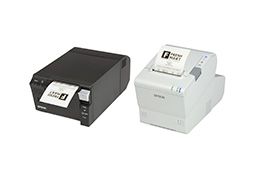
Intelligent receipt printer with peripheral control
The TM-T70II-DT2 and TM-T88VI-DT2 are next-generation receipt printers that integrate printer and PC functions to support smart store operations in conjunction with tablet devices and POS peripherals.
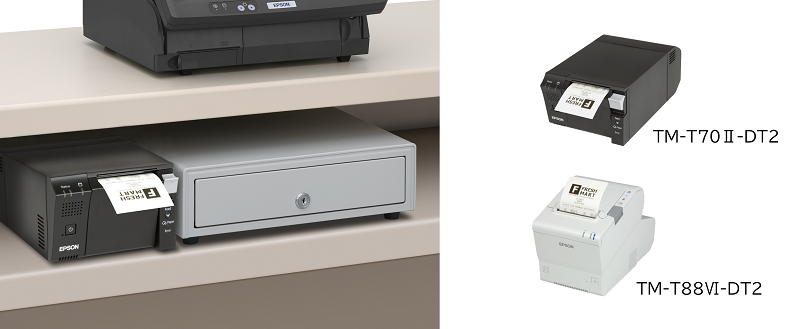
Simplified system configuration
Various interfaces for peripheral devices are provided. Since printing and control of peripheral devices can be performed via the Web regardless of the OS or type of terminal, the system configuration can be simplified.
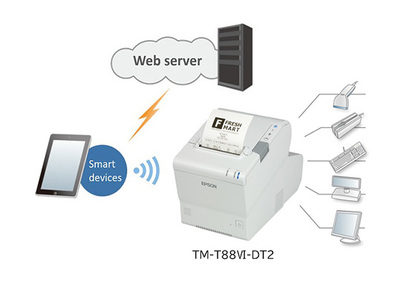
Reduced maintenance
Users always have access to the latest applications in the cloud, eliminating the need for service staff to install or update software, thereby reducing the environmental impact of human movement.
Flexible optimization of peripherals
The number of POS systems can be flexibly adjusted according to the level of customer demand, optimizing the number of active systems and contributing to reduced power consumption.
Compatible with all network devices
Since no dedicated PC is required and the systems are not dependent on the type of device or OS, power-saving devices such as smartphones can be used.
Resource-saving design
By using the paper saving function for standard receipt lengths, up to 49% 1 reduction in paper usage is possible.
1 Results are based on measurements using a proprietary evaluation pattern by Seiko Epson, which combines the paper saving function and the paper eject function. The actual reduction amount may vary depending on the printing pattern.
Other (textiles, labels, photos)
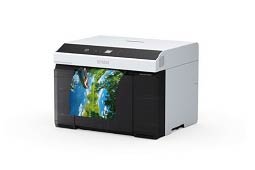
Innovating Production Processes with Digital Textile Printing
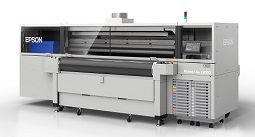
Reproduce prints of vivid and delicate designs with high productivity and low environmental impact.

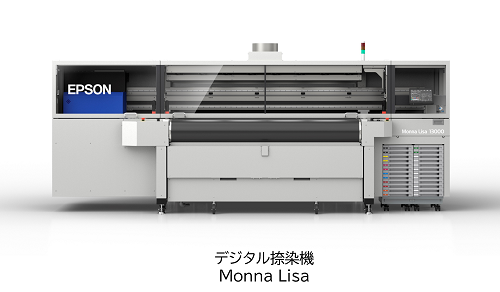
Digital Textile Printer
Efficient Production Processes
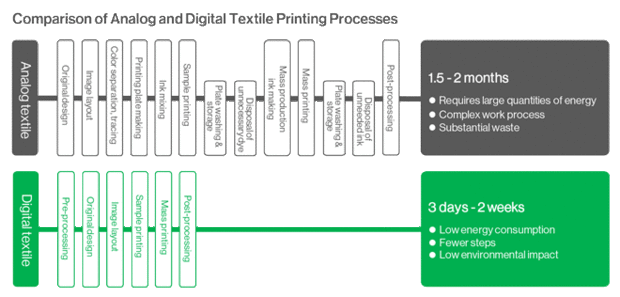
Epson's inkjet textile printers reduce the use of energy, water, materials, and time in the production process while expanding design possibilities. Digital textile printing is a method of printing digital data directly onto fabric. It has the following characteristics compared to analog printing, in which dedicated printing plates are pressed onto fabric.
- Fine gradations and subtle color tones can be reproduced
- Since no analog plates are required, the system is ideal for low-cost, short-run production of a wide variety of labels.
- Because there is virtually no waste of dyeing materials and no water is required for cleaning the printing plates, environmental impact is reduced.
Reduction of Water Use
It is estimated that approximately 20% of the world's wastewater comes from dyeing and processing of fabrics1.
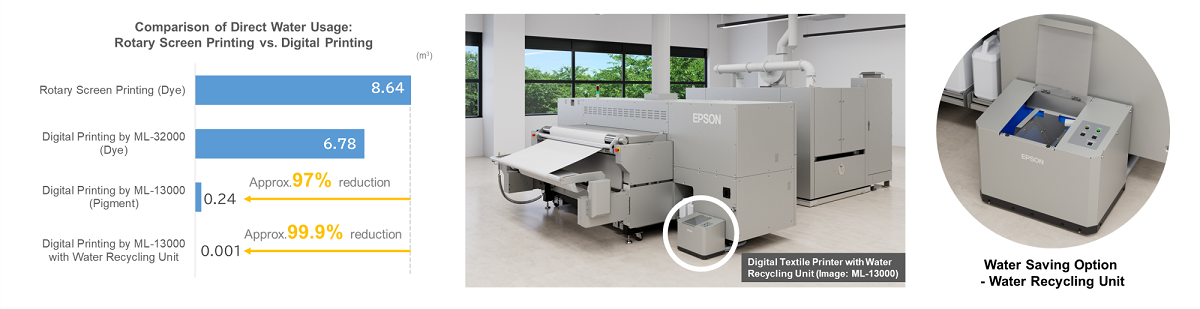
Digital textile printing eliminates the need for a plate cleaning process compared to analog (autoscreen) textile printing. In particular, digital textile printing using pigments does not require post-processing, making it possible to reduce the amount of water used by up to 97%2. Furthermore, by using the "Water Recycling Unit" in conjunction with the digital printing process, the water pollution level of the wastewater from the belt cleaning process is automatically detected, and the amount of recycled water is maximized, thereby reducing the amount of water used by up to 99.9%.
Going forward, we will gradually expand the range of models that this optional unit supports, contributing to the reduction of industrial wastewater in textile printing.
1 World Bank, 2019 How Much Do Our Wardrobes Cost to the Environment?
2 Comparison of the processes of rotary screen dyeing and inkjet dye/pigment printing by Monna Lisa in "Direct Water Usage Report for Digital Textile Printing (November 2024)," a commissioned study by Seiko Epson. The report compares the direct water usage for dyeing 300m of fabric with a width of 1.5m. The figures may vary depending on the usage environment and measurement conditions.
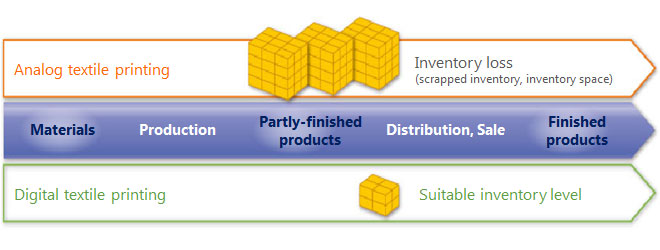
Proper inventory management
Digital textile printing has a short processing time of 3 days to 2 weeks from pre-processing to post-processing, making it ideal for small-lot, diverse production. It minimizes inventory losses of materials, work in progress, and finished products from production to distribution and sales.
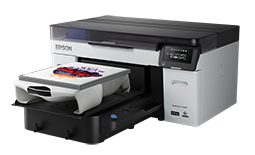
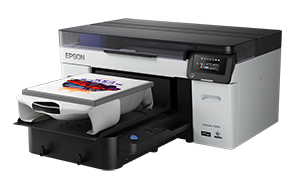
Revamping the workflow with inkjet technology to enable vivid and detailed garment1 printing
Epson applies its advanced inkjet technology to provide original printing on cotton products such as T-shirts, polo shirts, and tote bags, achieving vivid and delicate garment prints with a low environmental impact.
1 Garment refers to clothing and apparel.

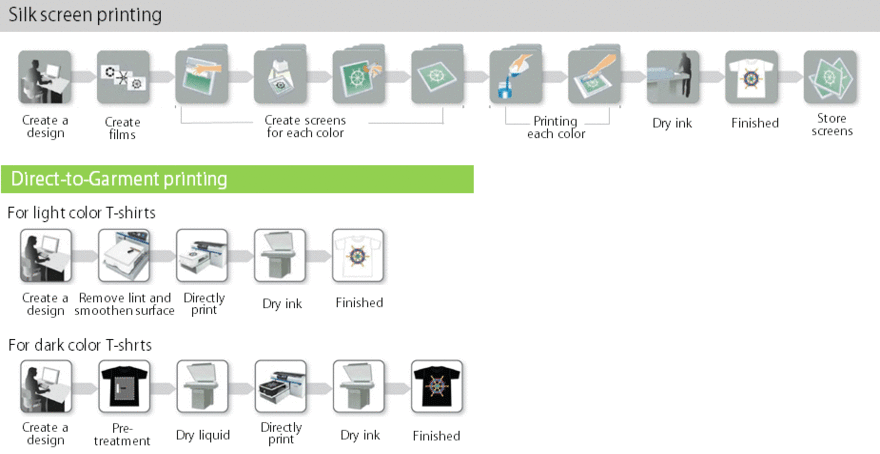
Transforming the garment printing workflow
Traditional silk screen printing requires printing preparation and maintenance, such as plate making and ink mixing. In addition, the long printing process for multicolor printing, which is necessary for gradation expression in photographs, consumes a large amount of energy, water, materials, and other resources.
Digital printing with the SureColor SC-F2250 directly prints digital data from a PC onto T-shirts and other garment products, eliminating the need for plate making. It also enables images and photographs to be printed in gradation and full color. In addition to shortening the garment printing workflow, it contributes to resource conservation and environmental impact reduction because it eliminates the need for film negatives, screens, and plates, as well as for washing and storing plates.
Safe for use on printed textile products that come into contact with infants and toddlers
Epson's UltraChrome DG inks and dedicated pre-treatment agents used in garment printers are certified under the "Eco Passport *2" international safety standard for textile products and also comply with ZDHC MRSL Level 1 *3. This is proof that they are safe to print on textile products that come into contact with infants and young children, so you can use them with peace of mind. Furthermore, they are GOTS *4 approved.
*2 This is a safety and security certification standard for chemical substance, specifically dyes, pigments, auxiliaries, and finishing agents used in the production of textile products.
*3 This indicates compliance with the ZDHC MRSL guidelines, based on analytical testing conducted under the "List of Controlled Substances at Manufacture (MRSL)," which prohibits the intentional use of chemical substance in the manufacturing process of textile products and other items. ZDHC: Zero Discharge of Hazardous Chemicals
*4 International standards for products made from organic textiles.

The UltraChrome DG inks and pretreatment liquid used in Epson's garment printers are Eco Passport 1 certified and complies with ZDHC MRSL 2 level1, indicating that they meet international safety standard for textiles. Under this standard, even printed textiles that directly contact the skin of infants and toddlers are safe. Additionally, the inks are approved with GOTS 3.
1 Eco Passport by Oeko-Tex ® is a system by which textile chemical suppliers demonstrate that their products can be used in sustainable textile production.
2 The evaluation is based on analytical testing in accordance with the Manufacturing Restricted Substances List (MRSL), which prohibits the intentional use of chemicals in the manufacturing process of textile products and others. It demonstrates compliance with the ZDHC MRSL Guidelines. ZDHC: Zero Discharge of Hazardous Chemicals.
3 An international standard for products made from organic textiles.
Providing the Value of Color Printing on Demand
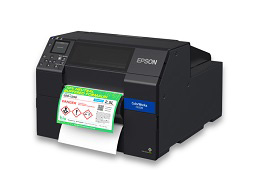
Easily print full-color labels, tickets and tags, when and where you need them.
Eliminate the need for large inventories of pre-printed labels by printing short runs of labels on-demand.
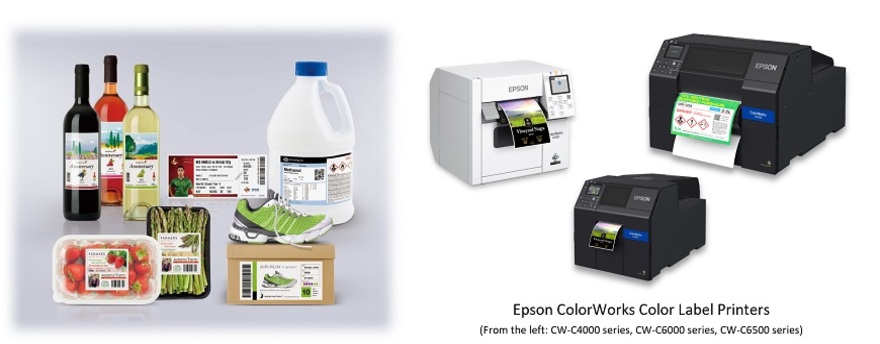
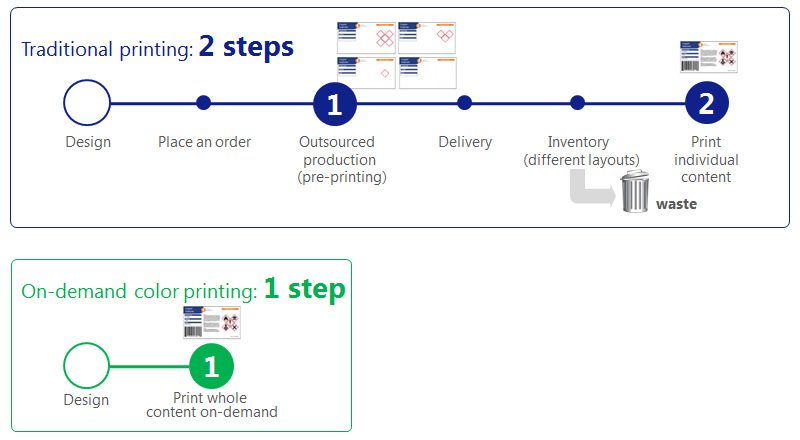
Simplifying the Traditional Label Printing Process
The traditional method of label printing involved ordering pre-printed sheets from an outside vendor, which had borders, logos, etc. that matched the requirements, and then overprinting them with a thermal printer. This method required storage space for the pre-printed sheets, and because the labels were printed twice, it was time-consuming and labor-intensive.
Epson's on-demand color label printers enable users to create custom color labels, tickets, tags, etc. in-house and on-demand with a single print. Because users no longer need to keep an inventory of labels, they eliminate label waste and production interruptions due to label shortages. They also eliminate the risk of missing important orders or late shipments.
Revamping the Photo Print Workflow with Inkjet Minilabs
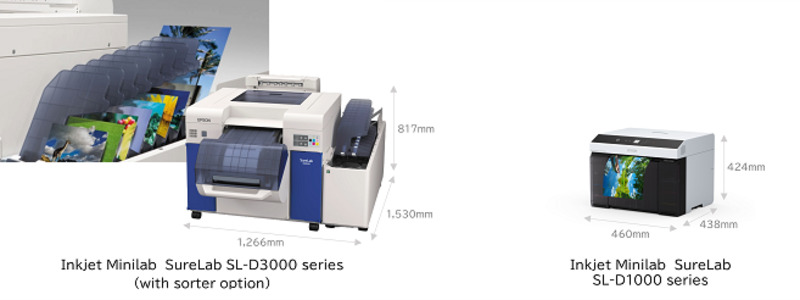
Epson's inkjet minilabs offer superior maintenance compared to traditional silver-halide minilabs, streamlining customers' photo printing workflows and reducing ongoing costs. With an efficient process, resource consumption is minimized, leading to a lower environmental impact.
Digital Printing for Efficient Photo Printing
Photo prints produced by a traditional minilab require maintenance 1 such as chemical adjustments and calibration at the start of the day and waste liquid processing and cleaning at the end of the day. In contrast, Epson SureLab SL-D3000 series and D1000 series inkjet minilabs require no special maintenance at the start or end of the day. Because they use no chemicals, waste liquid processing is not required, and the absence of chemical odors greatly improves the customer's work environment.
1 According to Epson research