Four Value-Creation Domains
In ENGINEERED FUTURE 2035, Epson identified the four areas below as those in which Epson will deliver value.
- Supporting energy and resource efficiency
- Supporting advances with precision technology
- Addressing labor shortages with productivity and reliability
- Supporting learning, working and lifestyles
Our contributions to these four domains are not based on separate resources. What supports everything is our efficient, compact and precise technology platform. We will not sell our technologies in isolation, but will deploy them in integrated, multidimensional ways and implement them in the real world. This is the growth model we are seeking to recreate now.
We introduce examples from each of the four domains of how Epson's technologies are already being applied, or how they will be applied in the future.
Supporting energy and resource efficiency
Summary
We recognize crucial challenges in the operating environment, including the advancement of decarbonization and increasing energy constraints, along with rising resource prices and supply instability. Against this backdrop, we believe demand will continue to grow for technologies that deliver both performance and productivity while reducing energy and resource consumption. Leveraging our inkjet technology, advanced materials, and resource recycling technologies based on Epson's efficient, compact and precise technologies and philosophy, we will help to save energy, increase manufacturing efficiency, and promote more effective use of resources, thereby reducing our customers' environmental impact while providing them with greater economic value. This type of value is provided primarily in the Precision Innovation segment.
Case study: Inkjet
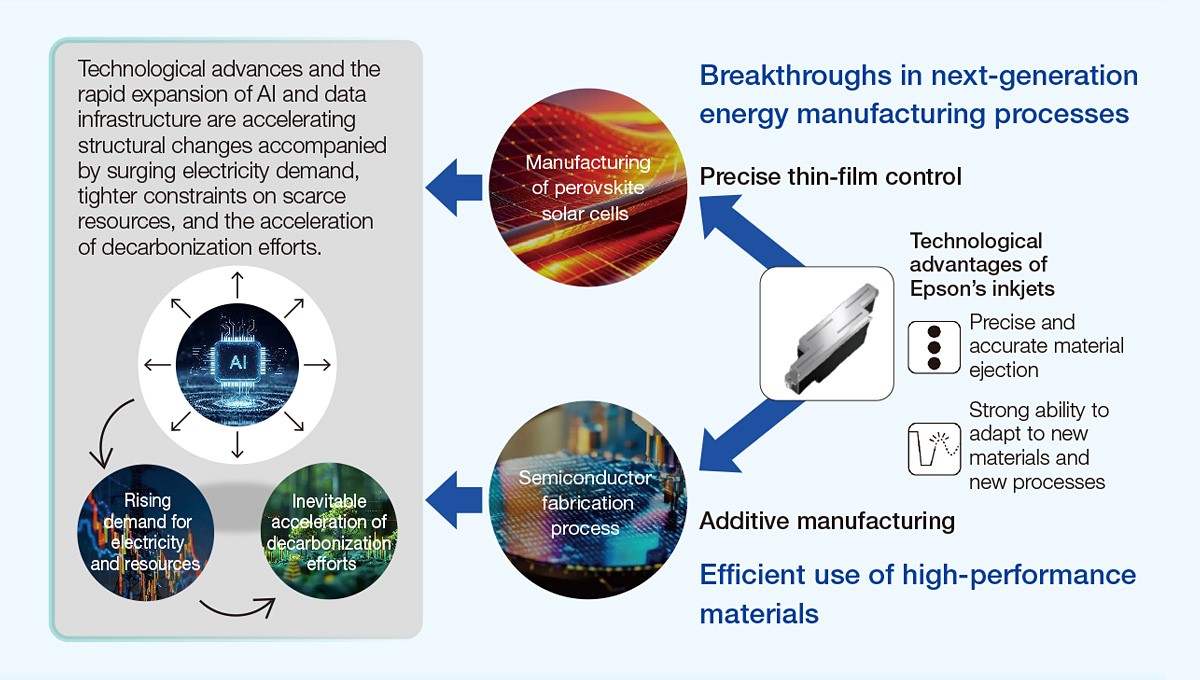
As AI and data infrastructure continues to expand, rapid growth in electricity demand and constraints on scarce resources are becoming major social issues. This is driving the need for innovation in manufacturing processes that use energy and resources more efficiently. Epson's inkjet technology leverages the strengths of additive manufacturing, enabling material to be precisely deposited in the right amount, in the right place, and at the right time. Leveraging this capability, we are expanding its applications beyond conventional printing into advanced manufacturing fields. Lying at the heart of this technology is PrecisionCore, printheads that incorporate thin-film piezoelectric actuators, ink channels, and nozzles fabricated using MEMS processing technology. This enables highly accurate control of microscopic droplets at the picoliter level. By enhancing the ability to handle not only printing inks but also functional materials, electronic materials, bio-based materials, and a wide range of other liquid materials, Epson is expanding possibilities for the deployment of new materials and new processes.
Because inkjet deposition is a non-contact process that does not directly touch the substrate, it can readily place materials on thin films, uneven surfaces, and flexible substrates, helping to reduce damage to substrates and to improve flexibility in process design. As a digital process that does not use plates or masks, it promises to reduce material loss, simplify processes, and enable more compact equipment. By leveraging precision ejection control and high adaptability to new materials and new processes, Epson is helping to reduce environmental impact and enhancing industrial competitiveness in next-generation fabrication processes for things such as semiconductors and perovskite solar cells.
Related Business segment
Supporting advances with precision technology
Summary
Demand is rapidly rising for devices that combine high precision, low power consumption, and high reliability. This demand is being driven by the expansion of AI, data centers, and the telecommunications and automotive fields. While we view this as an important business opportunity, adapting to accelerating technological advances and changes in the competitive environment is essential for maintaining our competitiveness. Leveraging our strengths in precision technologies that integrate precision microfabrication, MEMS, and crystal and materials technologies, Epson provides a foundation for accurately capturing and controlling the physical world, thereby contributing to the advancement of digital value in the real world. This type of value is provided primarily in the Precision Innovation segment.
Case study: Devices
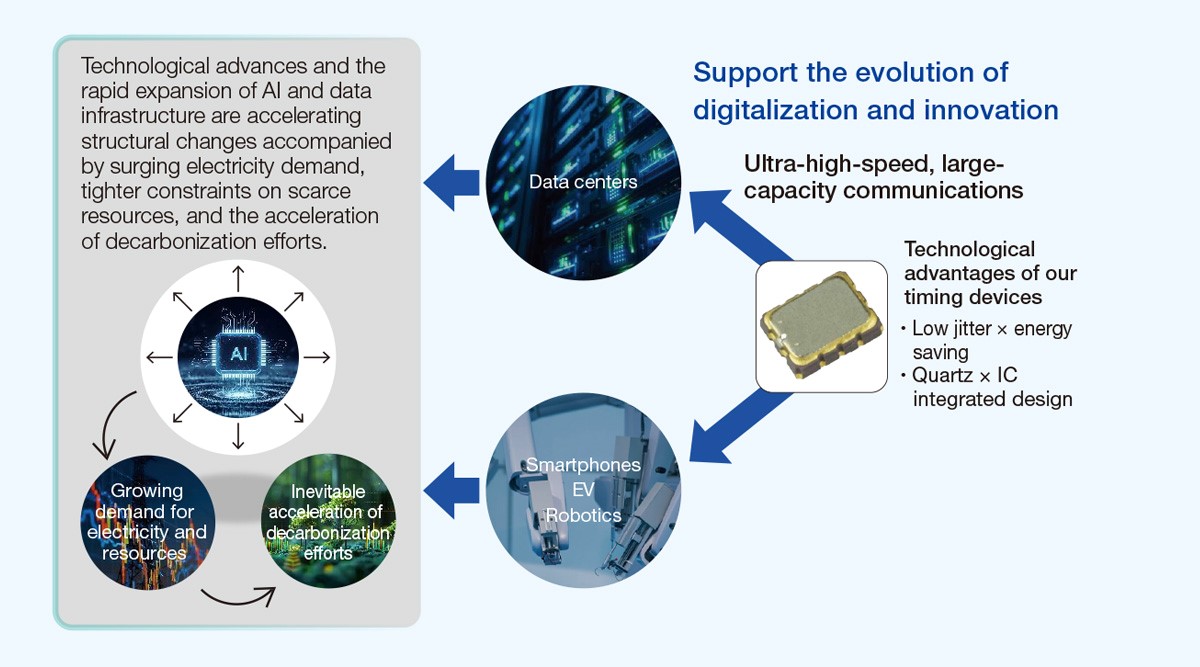
The advance of AI, data centers, high-speed communications, and mobility technologies such as EVs is driving demand for electronic devices that deliver ever-more accurate, smaller, energy efficient, and reliable. We are developing high-performance devices that underpin digitalization, technological innovation, and the modern world through the integration of our quartz crystal device, semiconductor, precision processing and packaging technologies, Among these, timing devices play a critical role in electronic equipment and communication systems by generating the precise reference signals that synchronize operations.
We maximize the inherent advantages of quartz crystal materials --namely their precision and stability --through advanced design and manufacturing technologies. By combining these capabilities with semiconductor and miniaturized packaging technologies, we provide devices with low jitter, low power consumption, and compact form factors without compromising performance. This contributes to stabilizing high-speed, high-capacity communications in data centers and communications infrastructure, enhancing the performance of electronic equipment, and improving the reliability required in the mobility field. Building on our efficient, compact, and precise technologies, we will continue to support the evolution of next-generation technologies by further advancing technologies that precisely control material characteristics and enable devices that combine stability, compact size, and high performance.
Case study: Materials
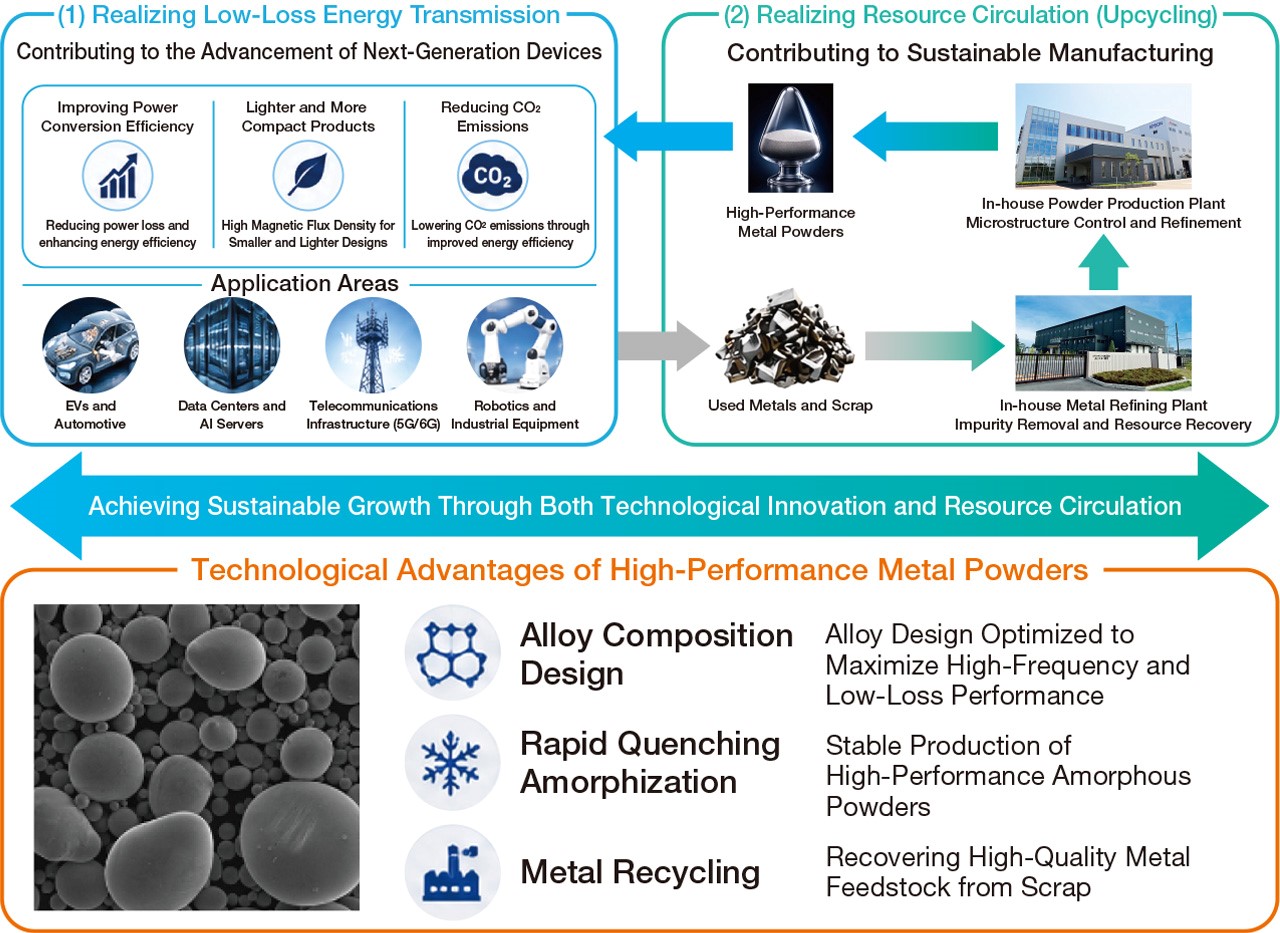
Rapid growth in AI and data centers has made rising electricity demand and improved energy efficiency critical societal challenges. Epson Atmix's amorphous alloy powders contribute to reducing power losses in power supply components and are seeing increasing adoption as materials that support energy-efficient data centers and AI servers.
A key strength of Epson Atmix lies in its unique technological platform, which integrates the entire value chain from materials development to powder production and processing using recycled materials. At the metal refining plant that commenced operations in 2025, we established a resource circulation system that recycles used metals and transforms them into high-performance metal powders, creating new value from recovered resources.
Furthermore, by developing materials and processing technologies and integrating them with digital technologies, we are advancing optimization across the entire value chain, from material design to mass-production processes. This is allowing us to strengthen our competitiveness in growth markets while achieving both enhanced product performance and resource circulation.
Related Business segment
Addressing labor shortages with productivity and reliability
Summary
With a declining labor pool in developed economies and a shortage of skilled labor in emerging economies, we recognize that maintaining both sufficient labor and product quality at manufacturing sites has become a crucial challenge. Rising labor costs and difficulties in transferring skills are also challenging the sustainability of conventional operations. Leveraging Epson's robotics and commercial and industrial printing businesses, we will advance automation and process optimization using control and AI technologies to both save labor and improve quality, thereby making manufacturing more sustainable. This type of value is provided primarily in the Industrial & Robotics segment.
Case study: Robotics
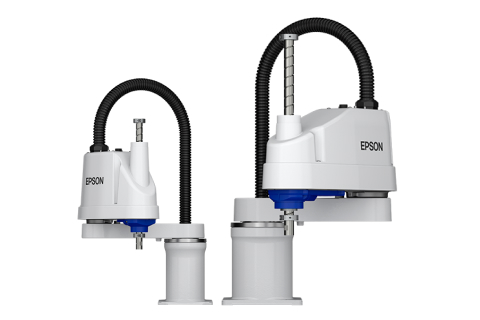
To address labor shortages and rising production costs, we introduced the LA3/6-A series of SCARA robots. With a carefully selected set of functions, the design delivers high cost performance while maintaining lightweight and compact form factors as well as exceptional precision and reliability. These versatile robots save labor and increase productivity in regions around the world, including China, where price competition is intense.
Case study: Commercial & Industrial Printing
Direct-to-Film (DTF) technology has attracted attention in recent years in the apparel printing and goods market.
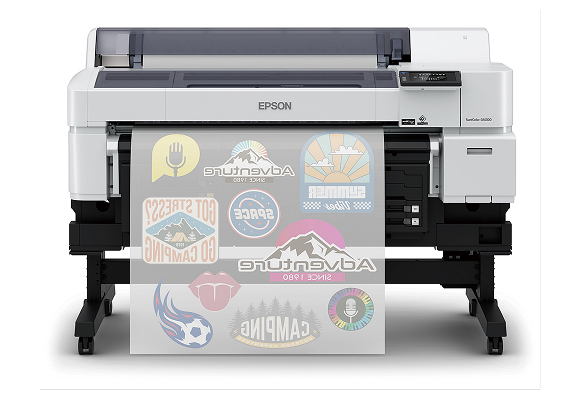
Launched in May 2025, the SC-G6050 is Epson's first dedicated DTFilm printer for textiles. We were able to commercialize this printer in a relatively short period of time by leveraging a platform comprising hardware, printhead, and ink that was developed in our textile printing business.
This product prints ink directly onto dedicated film, applies and heat-dries hot melt powder, and transfers the design onto T-shirts or other fabrics using a heat press. It is capable of full-color printing on a wide range of materials, including cotton, nylon, and polyester. It also offers both stable operation and a reduced maintenance workload, an issue with conventional DTF printers.
By bundling it with Fiery's Digital Factory software1, which has a track record in the DTF field, we maximize printer performance and improve printing process efficiency and high-quality output.
1 Only with Europe and U.S. specifications

Related Business segment
Supporting learning, working and lifestyles
Summary
Demand for access to education and information is rising in developing economies as their populations grow and their middle class expands. Meanwhile, delayed infrastructure development and widening disparities pose critical social challenges and constraints on growth. We also recognize that changes in how people work and advances in digitalization are driving a need for greater information visualization and information sharing as well as higher operational efficiency.
Equipped with visual communication technologies, Epson supports improved information access and operational efficiency, contributing to enhanced quality of learning, working and lifestyles while also delivering value through growth in emerging economies and productivity improvements in developed economies. This type of value is provided primarily in the Office & Home Printing segment and Visual & Lifestyle segment.
Case study: Printing
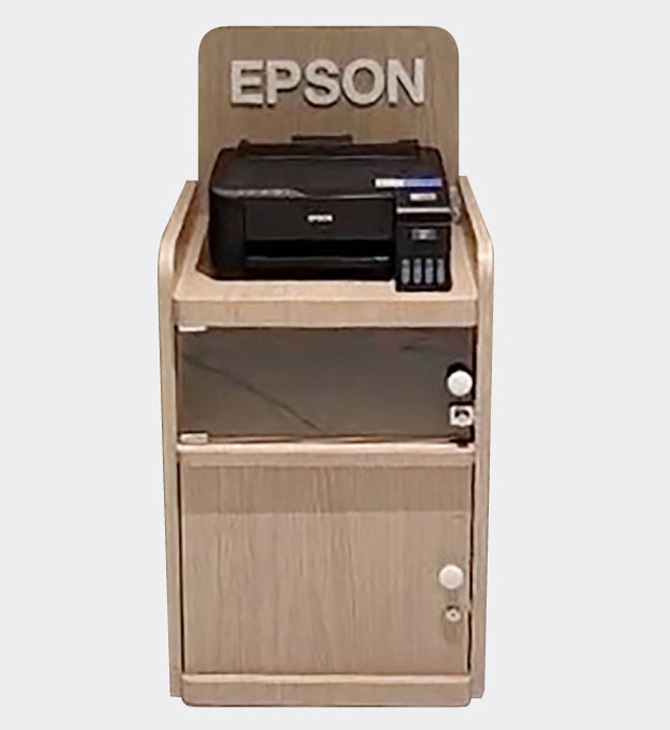
In China, Epson has installed high-capacity ink tank printers in convenience stores as well as in parcel collection and delivery locations to provide printing services. This has allowed us to enhance printing convenience while also aiming to capture demand for at-home printing and new printing needs. In rolling out these services, we are collaborating closely with co-creation partners to incorporate features that improve ease of use, thereby delivering services with higher customer value.
We are also expanding this concept into the Middle East and India, strengthening the value we provide to customers by offering not only hardware sales but also peripheral solutions. We will continue to collaborate with co-creation partners to propose optimal solutions that meet customer needs, expanding deployment areas and value delivery and linking this to sustainable growth.

Related Business segment
Related information
Official Account