Organization, Initiatives, and External Recognition
Epson's Intellectual Property Organization
Organizational Structure of Epson's Intellectual Property Division
To formulate and implement intellectual property strategies, Epson's Intellectual Property Division is equipped with functional organizations that handle all types of intellectual property rights. Additionally, each functional organization collaborates with the technology development division and operations divisions to formulate, implement, and promote intellectual property strategies. To support this, intellectual property staff are assigned to correspond with each of the technology development division and operations divisions.
Intellectual property activities at Epson are implemented by an extensive organization that encompasses the approximately 200-person staff of Seiko Epson's Intellectual Property Division along with the personnel with IP duties within Seiko Epson's technology development division and operations divisions and within domestic and overseas Epson Group affiliates.
In April 2024, the Intellectual Property Division established a new organization that consolidates the innovation support function utilizing IP landscape, the contract review function that leads innovation to results, and the trademark management function that enhances brand identity. This initiative was undertaken to accelerate the achievement of Level 5 in the value hierarchy1 of intellectual property activities. By strategically and integrally implementing intellectual property strategies aimed at achieving Level 5 within the new organizational structure, we will strongly support innovation.
1 For more information, please see the "Intellectual Property Strategy" page.


Global Coordination of Intellectual Property Activities
Epson's Intellectual Property Division located in Japan manages our IP activities worldwide. The Intellectual Property Division works with the legal, intellectual property, and sales and marketing departments of domestic and overseas Epson Group affiliates to resolve intellectual property issues, conclude agreements, and lead coordination of measures against counterfeits in each region of the world.

Advancing Intellectual Property Operations Through Dialogue with Generative AI
At Epson's Intellectual Property Division, we use generative AI not merely as a tool for improving operational efficiency, but as a partner that helps us deepen our questions and improve the quality of our judgment. We are incorporating insights gained through trial and error in day-to-day operations into standard prompts and business processes, transforming individual ingenuity into organizational capability.
Rethinking the Value of Intellectual Property
In recent years, generative AI has rapidly become widespread and is bringing significant changes to intellectual property operations. Its use is expanding beyond improving the efficiency of routine tasks such as drafting and summarization to more advanced areas, including invention discovery, patent information analysis, and the development of intellectual property strategies.
At Epson, we view intellectual property not simply as an asset for obtaining and managing rights, but as a management resource that connects technology and business and creates customer value and competitiveness. Accordingly, our adoption of generative AI is not aimed solely at improving existing operations. As we explore new ways of working built around generative AI, we seek to strengthen our fundamental ability to create value from intellectual property.
Expanding the Use of Generative AI in Three Phases
We view the use of generative AI in intellectual property operations in the following three phases.
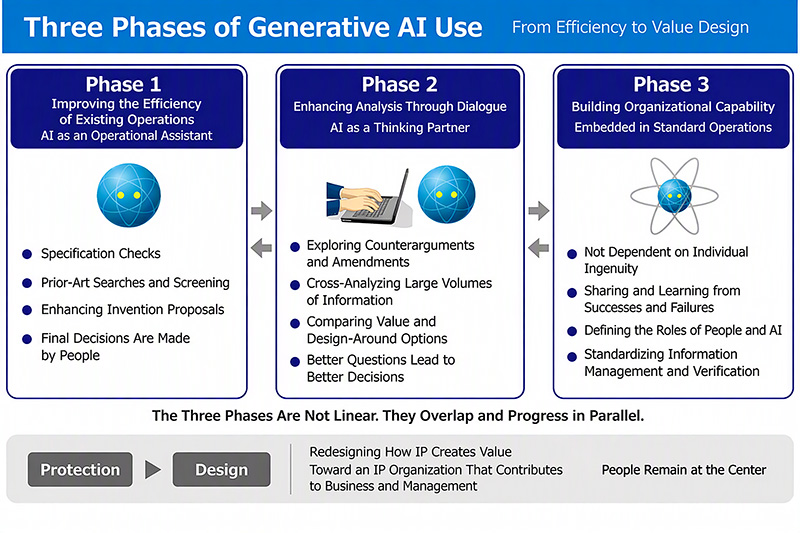
Phase 1 (Evolution): Improving the Efficiency of Existing Operations
Generative AI supports tasks such as organizing information and checking formats, while people verify the results and make the final decisions. By reducing the time spent on routine tasks, people can devote more time to examining the essence of inventions and their business value.
Phase 2 (Deepening): Enhancing Analysis Through Dialogue
Generative AI is used as a thinking partner to formulate hypotheses and compare multiple options. Rather than accepting AI-generated answers at face value, people continue the dialogue while changing assumptions and evaluation criteria, leading to higher-quality judgments.
Phase 3 (Expansion): Embedding AI Use as an Organizational Capability
Effective methods of using generative AI are standardized and deployed across the organization. In addition, the information-analysis and insight capabilities cultivated through intellectual property activities are extended to areas such as R&D theme evaluation, exploration of new business opportunities, and alliance considerations, thereby contributing to greater business value.
Use Cases Originating in Day-to-Day Operations
Case 1
In patent application work, we use generative AI to review invention disclosure forms, conduct prior-art searches, compare inventions with prior documents, and check the format of patent specifications. For invention disclosure forms, generative AI helps identify the characteristics of an invention, differences from prior art, and the content of embodiments, making missing information visible at an early stage. This enables discussions with inventors to progress beyond simply confirming written content toward examining the essence of the invention and the approach to securing intellectual property rights.
We are also exploring a system that links generative AI with patent search tools to support a continuous workflow, from entering an invention disclosure to searching for similar documents and preparing a proposed patent filing strategy. In the future, we aim to use this approach to conduct searches and analyses in real time during idea discussions with inventors, helping to deepen those discussions.
Case 2
In addition to searches conducted for patent applications, we are piloting the use of generative AI in FTO (Freedom to Operate) searches, which assess the risk of infringing third-party patents when conducting business. Traditionally, search results were narrowed down and relevant documents were reviewed individually by people. We are now testing an approach in which search results are not narrowed excessively, generative AI performs the initial screening, and people then review the results. Our aim is to improve both search quality and operational efficiency while reducing the risk of overlooking patents that require review.
People Remain at the Center in the AI Era
Intangible assets such as intellectual property, brands, data, and know-how do not create sufficient value merely by being managed individually. It is important to envision how these assets can be combined and connected to customer value and competitive advantage. Intellectual property functions are therefore expected not only to secure rights and manage risks, but also to support future value creation.
Generative AI is a powerful support tool, but people decide what questions to ask, what choices to make, and what future to envision. Through dialogue with generative AI, we refine our own questions and judgments, bring those insights into dialogue with others, and turn them into organizational strength. In doing so, we will further advance the value we provide to business and management.
Intellectual Property Education to Strengthen the Foundation of Intellectual Property
Epson offers various courses in intellectual property education to employees, all of whom have a part to play in the company's value creation story. The aim is to strengthen the intellectual property foundation that supports the growth strategies of each business and to further accelerate value creation at Epson. This will be achieved by enabling employees to acquire and deepen the intellectual property knowledge necessary for their roles, and by developing human resources who can protect and utilize intellectual property in cooperation with the Intellectual Property Division.
Intellectual property education is mandatory for new hires as well as for advancement and promotion to management positions. In addition, technical engineers must acquire the intellectual property knowledge, skills, and perspective necessary for their respective positions in the hierarchy. We also have specialized courses that focus on the acquisition of knowledge and tips to facilitate co-creation and the acquisition of technical search skills. Additionally, we have established courses for our sales and administrative staff according to their positions.

A feature of Epson's intellectual property education is that it provides all employees with not only the basic knowledge of intellectual property, but also the highly specialized intellectual property education required according to their roles.
In addition, the Intellectual Property Division develops personnel who, based on intellectual property strategies, can acquire BP (Brilliant iP) through a combination of group education and on-the-job training. Furthermore, we are developing human resources through participation in two-party discussions between the head of the Intellectual Property Division and the head of each operations division and the head of the Technology Development Division, as well as through participation in the Intellectual Property Committee of external organizations that study and examine intellectual property systems. Through these experiences, we are cultivating intellectual property professionals who can formulate and implement intellectual property strategies, proactively support innovation and growth strategy scenarios, and respond to various intellectual property issues around the world.
External Recognition of Epson's Intellectual Property Activities
Epson has been acquiring and utilizing its proprietary core technologies and services in the form of various intellectual property rights. These achievements have been highly praised by various external organizations. Some of the recent examples are introduced below.
Recognition at the External Invention Awards
Epson's inventions have been highly praised in the National Commendation for Invention and the Regional Commendation for Invention organized by the Japan Institute of Invention and Innovation. Since the 1970s, we have received numerous awards.
2026: WIPO Prize at the National Commendation for Invention
"Invention of a Compact and Cost-Effective Piezoelectric Inkjet Printhead Structure" (Japanese Patent No. 5958568)
Epson received the WIPO Prize2 at the 2026 National Commendation for Invention for its "Invention of a Compact and Cost-Effective Piezoelectric Inkjet Printhead Structure."
The invention provides a structure in which a piezoelectric element is formed by sequentially stacking a lower electrode, a piezoelectric layer composed of a thin-film piezoelectric material, and an upper electrode. The piezoelectric layer serves as an interlayer insulating layer between the upper and lower electrodes, while the upper electrode serves as a protective film for the piezoelectric layer. Accordingly, an interlayer insulating film and a protective film are not required, thereby reducing the number of constituent layers to the minimum necessary. As a result, a larger displacement of the piezoelectric element is achieved, enabling a high degree of miniaturization of the actuator while maintaining a sufficient ink ejection volume, and consequently achieving both compactness and cost-effectiveness of the overall inkjet printhead. Furthermore, in regions where stress is concentrated, local stiffness is increased through optimization of the electrode arrangement and refinement of the wiring structure. This suppresses crack formation and ensures high reliability.
The invention is implemented in Epson's PrecisionCore Micro TFP printheads. These printheads are incorporated into Epson-branded inkjet printers for office as well as commercial and industrial applications and are also supplied to many commercial and industrial printer manufacturers. In addition, their application is expanding into new fields, including semiconductor manufacturing processes. In addition to delivering high-resolution and stable printing performance, the invention promotes the transition from conventional printing methods to inkjet printing, thereby contributing to reduced environmental impact through lower power consumption and reduced waste.
2 The WIPO Prize is a special prize of the National Commendation for Invention. It was established in 2023 with the support of the World Intellectual Property Organization (WIPO).


2024: Prize of the President of the Japan Patent Attorneys Association at the National Commendation for Invention
"Invention of a mechanical wristwatch using a high-precision silicon escape wheel to enable drive for long periods of time" (Japanese Patent No. 6891622)
Epson received the Prize of the President of the Japan Patent Attorneys Association at the 2024 National Commendation for Invention for "The invention of a mechanical wristwatch using a high-precision silicon escape wheel to enable drive for long periods of time." This is the first time in 50 years that the invention of a mechanical wristwatch has received a special award at the National Commendation for Invention. The last time was in 1974, when we received the Prime Minister's Prize.
The present invention uses a silicon material in the escape wheel, an important component of mechanical watches. The escape wheel of the present invention includes a plurality of spring portions that make use of silicon's flexibility. The spring portions are formed by MEMS processing, which has been used in the processing of printheads. The spring portions press against protruding parts on the pinion from the periphery so that, without the use of adhesive, the centers of the escape wheel and of the pinion can be aligned without eccentricity. In addition, by inserting the tip sections of the silicon escape wheel into recesses in the pinion, the escape wheel and the pinion can rotate integrally.
The present invention allows for a significant reduction in driving energy loss by rotating a lightweight, precisely produced silicon escape wheel without eccentricity. This invention is used in a skeleton type Orient Star mechanical wristwatch. By mounting the escape wheel of the present invention and by making the mainspring long and thin, it was possible to extend the running time to a maximum of 70 hours (20 hours longer than the conventional metal escape wheels) while maintaining time accuracy, thereby realizing a mechanical wristwatch that does not require time adjustment at the beginning of the week.

2022: Minister of Education, Culture, Sports, Science and Technology Prize at the National Commendation for Invention
"Invention of a method to reduce printing unevenness during bidirectional printing with inkjet printer" (Japanese Patent No. 4635762)
Epson received the Minister of Education, Culture, Sports, Science and Technology Prize at the 2022 National Commendation for Invention for "The invention of a method to reduce printing unevenness during bidirectional printing with inkjet printer." The invention relates to bidirectional printing by an inkjet printer in which a printhead is reciprocally scanned over a paper surface to form dots. In the invention, dots formed during forward scanning and dots formed during reverse scanning are distributed to avoid poor uniformity in distribution. Implementation of this invention makes it possible to print images of outstanding quality at high speeds because the dots are distributed evenly even if they are misaligned in reciprocal scanning. The invention enables inkjet printers for home, business, photography, and commercial and industrial use that produce amazing output at high speeds. It also helps to reduce environmental impact, improve productivity, and foster a culture of photography, art, and more.


2021: Prime Minister's Prize at the National Commendation for Invention
"Invention of a high-brightness, high-image-quality projector using monochromatic laser light source" (Japanese Patent No. 5928569)
Epson received the Prime Minister's Prize at the 2021 National Commendation for Invention for "The invention of high-brightness, high-image-quality projector using monochromatic laser light source." The invention focused on the fact that a desired color of light can be generated by irradiating a phosphor material with laser light. A phosphor wheel is irradiated by monochromatic laser light, and red, green, and blue light are then produced from the resultant fluorescent light (yellow = red + green) and the monochromatic laser light (blue) and used as projection light. The laser light source is set to be digitally dimmed by pulse width modulation with high frequency to prevent image flickering. The invention has promoted the use of laser projectors and expanded projector use into applications such as signage and spatial design in stores, facilities, and events. This invention has also helped to open up a new world of image expression called digital art, such as projection mapping and covering entire spaces with images.
The two inventors of this invention received the Science and Technology Award (Development Category) from the Minister of Education, Culture, Sports, Science, and Technology in the field of science and technology for 2023.


2019: Asahi Shimbun Prize at the National Commendation for Invention
"Invention of a dry-process office papermaking system" (Japanese Patent No. 6127882)
Epson received the Asahi Shimbun Prize at the 2019 National Commendation for Invention for "The invention of a dry-process office papermaking system." This "two-stage sieve" invention is one of the core technologies of the Dry Fiber Technology found in a dry process office papermaking system, which can make new paper from used paper on the spot. This invention enabled a dry process office papermaking system in which fibers obtained by defibrating used paper are separated and sifted using a first sieve with a fine mesh and then deposited in uniform sheet after passing through a second sieve to produce new sheets of paper.

Other External Recognition of Epson's Intellectual Property Activities
Epson's intellectual property activities have received various high praises from external organizations as well. Below are examples.
2023: Intellectual Property Achievement Award from the Commissioner of the Japan Patent Office
Epson received the Japan Patent Office Commissioner's Award in recognition of its IP activities in the area of design at the Intellectual Property Achievement Awards 2023. This marked the second time that Epson has received an Intellectual Property Achievement Award, the first being in 2008, when Epson was recognized with the Minister of Economy, Trade and Industry Award as an enterprise that effectively uses the patent system. It is exceptionally rare for an enterprise to receive the Intellectual Property Achievement Award more than once. This award is a testament to Epson's commitment to carrying out its intellectual property strategy.
This award was given in recognition of Epson's strategic use of design registration for interior designs, which became eligible for protection under Japan's revised Design Act (2019). Epson used this system to gain protection for indoor layouts involving large-format printers. The Patent Office rewarded Epson for having advertised the fact that it registered these designs in product promotions. Epson showcases examples of these registered layout designs on its website and at exhibitions.
The points that were appreciated and recognized for the Intellectual Property Achievement Award are as follows:
- The IP departments proactively carried out IP activities after integrating IP strategy with business strategy in close collaboration with management, the businesses, and development departments, with the goal of realizing the corporate vision of achieving sustainability and enriching communities based on the Corporate Purpose. For printers, the IP staff discussed the strategy with the responsible executive officer and participated in product design development, even considering customer use cases. They then moved to acquire the resulting intellectual property rights (including layout designs for customer product use scenarios).
- The designs for the printers were developed to create new added value in customer use cases in which the printers are arrayed. With this in mind, Epson began building a portfolio of designs not only for the printers themselves but also for layouts (interior designs) in which they could conceivably be used by customers.
- In sales promotions, Epson states that it was the first company to acquire design rights in the large format printer category for printer layout designs under the revised Design Act. Epson utilized design rights as a medium to capture customer interest and empathy and is trying to expand these activities to other equipment as well.

2026: Epson Selected as One of the Clarivate Top 100 Global Innovators 2026
Ranked 6th in the World
Epson was listed among the Clarivate Top 100 Global Innovators 2026 announced by global information services firm Clarivate Plc., and was ranked 6th in the world in this year's inaugural ranking. This was the 13th time that Epson has been named to the list since its inception in 2012.
The Clarivate Top 100 Global Innovators
Clarivate compares and analyzes invention data from around the world, assesses the quality of patent ideas using indicators directly linked to innovativeness, and annually selects companies and organizations that are at the top of the global innovation ecosystem and continuously demonstrate outstanding innovation performance.
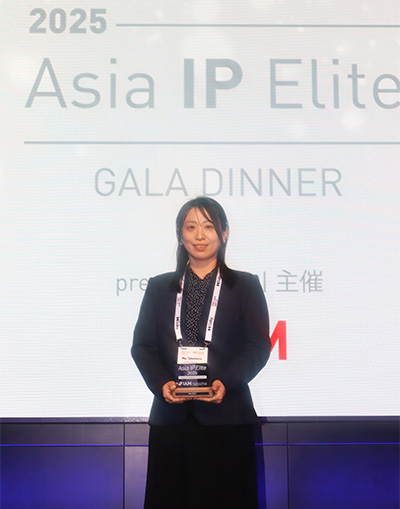
2025: Epson Selected as One of IAM's 2025 Asia IP Elite
Epson was listed among the 2025 Asia IP Elite by Intellectual Asset Management (IAM), a leading international intellectual property media organization. Twenty-five Japanese companies were selected, including Seiko Epson.
Asia IP Elite
Every year, IAM evaluates companies and organizations from a quantitative and qualitative perspectives and recognizes companies and organizations that excel in intellectual property value creation. The award recognizes companies that place intellectual property strategy at a pivotal place in their business, proactively utilize intellectual property and handle disputes arising from intellectual property, and promote innovative approaches to converting intellectual property into value
Official Account