Environmental Management
As stated in its Management Philosophy, Epson is committed to respecting the global environment and anchors its business activities on this principle. Additionally, addressing the growing social and customer interest in low environmental impact, Epson aims to deliver customer value with its unique and innovative technologies that surprise and delight. Furthermore, to carry out environmental programs under uniform standards and goals in every country and region of the world, the basic environmental stance is set forth in Epson Principles of Corporate Behavior
and in the Environmental Policy / Vision .
- Environmental Management System
- Promotion Organization
- Product Lifecycle Environmental Impact Reduction
- Environmental Performance
- Green Bonds
Environmental Management System
Business units within the Epson Group establish their own environmental action plans based on the Environmental Vison and the Corporate Vision, and carry out the activities using an Environmental Management System (EMS). We conduct internal audits to check performance against the plans and take corrective action against nonconformances.
We operate our EMS in compliance with the international ISO 14001 international standard, and we implement a planning and control cycle to effect continuous improvement. Epson's main global manufacturing, sales, and service sites are pursuing integrated business process and environmental management initiatives as required by ISO 14001 (2015), and are renewing their certifications.
Our environmental activities cover our consolidated subsidiaries. For FY2024, we collected data from 64 Group companies (covering 99% of consolidated revenue).
Promotion Organization
We are implementing environmental actions under company-wide sustainability management to enhance the feasibility of achieving the goals setforth in Environmental Vision 2050 and the Corporate Vision, ENGINEERED FUTURE 2035.
Related Information
Product Lifecycle Environmental Impact Reduction
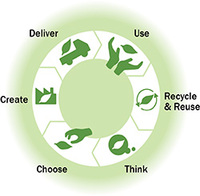
Epson is a manufacturing company, and the environmental impact generated during the manufacture and provision of its products is inevitable. in order to reduce environmental impact of products, it is essential to take a viewpoint that considers the entire product lifecycle.
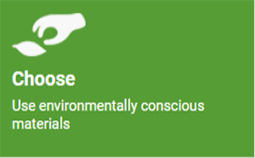
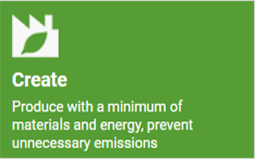
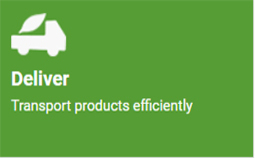
Based on this thinking, we have incorporated the concept of life-cycle thinking into our environmental management, which considers environmental impact across the entire product life cycle , from product design (Think), procurement of raw materials (Choose), manufacturing (Create), transportation (Deliver), customer usage (Use), to disposal and recycling (Recycle & Reuse). Together with our customers and business partners, we will work to reduce environmental impact our products and services.

Environmental Performance
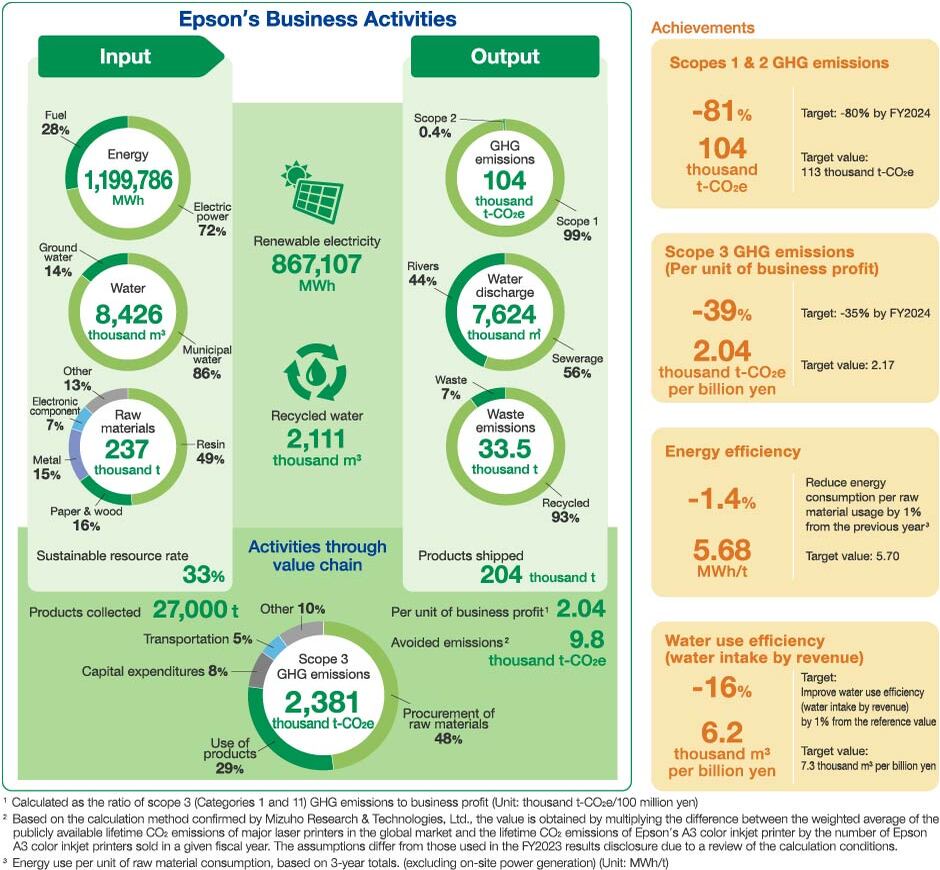
Epson consumes resources and, in the process of conducting business activities across the life cycles of its products and services, emits GHGs and other emissions to the air, land, and water.
We are working to assess the environmental impacts of our business activities across the value chain in an effort to reduce our impacts.
Material Balance (FY2024)
Green Bonds
Under its long-term vision, ENGINEERED FUTURE 2035, Epson contributes to enhancing environmental value in society through its products and services while also working to reduce the environmental impact of its own business activities to support the sustainable creation of that value.
To help advance these initiatives, Epson issued a green bond in September 2026. The proceeds will be used to refinance existing expenditures related to (1) capital investments for inkjet-related products and (2) renewable electricity purchases. The projects financed through these proceeds all meet the eligibility criteria.
The green bond was developed in accordance with the Green Bond Principles 2025 published by the International Capital Market Association (ICMA) and the 2026 Green Bond Guidelines issued by Japan's Ministry of the Environment. In addition, Rating and Investment Information, Inc. (R&I), an independent external reviewer, has provided a second-party opinion confirming alignment with these principles.
Please refer to the link below for details of the green bond issuance of July 2020 (¥50 billion of the ¥70 billion issuance has already been redeemed) and the associated green bond framework.
Social Media UseSocial Media Use