Epson to Emphasize ROIC and Seek Sustained Growth by Redesigning Its Business Portfolio and Focusing Resources on Growth Domains
- Epson introduces the ENGINEERED FUTURE 2035 Long-Term Corporate Vision and Mid-Term Business Plan, Phase 1 -
- TOKYO, Japan, March 13, 2026 -
Seiko Epson Corporation (TSE: 6724, "Epson") has unveiled ENGINEERED FUTURE 2035, a Long-Term Corporate Vision that maps out the company's strategy to 2035, along with a new Mid-Term Business Plan (2026-2028) that represents the first phase of work under the vision. In line with this plan, Epson will use ROIC as a management metric to optimize capital allocation, redesign its business portfolio, and focus resources on strategic growth domains. By transforming the earnings base and leveraging our precision technologies to expand in growth domains, the company aims to sustain corporate value growth.
Highlights
- Epson unveiled its Long-Term Corporate Vision, ENGINEERED FUTURE 2035.
- Capital allocation is to be optimized using ROIC as a management metric, with an FY2028 ROIC target of 8% or more.
- Define growth domains and invest approximately ¥280 billion in growth over three years.
- Pay out a minimum dividend on equity (DOE) of 3% and complement it with flexible share buybacks to deliver higher shareholder returns.
Long-Term Corporate Vision ENGINEERED FUTURE 2035
Refining our technologies, engineering the future and delivering real-world value
Epson sees the next decade as one in which volatility is the norm. Environmental and geopolitical risks will rapidly change, resources and energy will be increasingly constrained, and demographic changes will result in labor shortages worldwide. In developed economies, the labor pool continues to shrink. Meanwhile, emerging economies face critical challenges to develop foundational capabilities such as skills, education and infrastructure.
Under these conditions, the sustainability of society and industry will increasingly depend on how effectively we can use limited resources, energy, and human potential. It is not enough to evolve technology itself. Driving advances in the technology itself will not be enough. The ability to design and optimize technology so that it genuinely functions within society is becoming increasingly critical. It is precisely because of the many constraints that we believe the future should not be left to chance but must be methodically engineered, starting with technology that is conceived in the field and continuously refined and implemented in the real world.
That is why Epson seeks to leverage the efficient, compact, and precise technologies and philosophy it has developed over more than eight decades, building on the foundation of "Sho-Sho-Sei," to create value that supports the transformation of society and industry through real-world implementation. The essence of Epson lies not in advancing technology for its own sake, but in translating advanced technology into things that are genuinely useful in the real world. Engineering is the force that connects the philosophy of efficient, compact and precise innovation to meaningful social implementation.
We will deliver new value to the world by combining our efficient, compact, and precise technologies with designs optimized for real-world uses. From industry and across learning, working, and living, we will enhance productivity and reliability and expand the world's possibilities. So that people and the planet can continue to advance together, we will simultaneously raise both social value and corporate value. That is the future that Epson envisions in ENGINEERED FUTURE 2035.
Mid-Term Business Plan, Phase 1 (2026-2028)
Achieving both growth and capital efficiency by optimizing capital allocation based on disciplined ROIC management
Epson's Mid-Term Management Plan, Phase 1 (2026-2028), is the first stage of the company's journey toward realizing the ENGINEERED FUTURE 2035 long-term vision.
Until now, Epson's business structure has been highly dependent on mature markets, presenting challenges in terms of resource allocation to growth areas, execution speed, and capital efficiency. In Phase 1, Epson will confront these challenges head-on, transforming the earnings base and focusing resource allocation on growth domains. Management will emphasize capital efficiency, using ROIC as the primary management metric. By exercising disciplined ROIC-based management, Epson will aim to achieve a ROIC of 8% by fiscal 2028 and to build a solid foundation for sustainable growth.
Specifically, Epson will review its fixed cost structure and asset efficiency, redesign global operations and the supply chain, and strengthen sales in emerging markets. It will simultaneously expand and enhance recurring business and solutions. These efforts will enable Epson to reduce invested capital while enhancing the earning power of its businesses. At the same time, the company will prioritize the allocation of the cash generated to future growth domains, accelerating the transformation of its business portfolio. Capital will be optimally allocated, with investment and business decisions made based on disciplined ROIC.
Cash created through this transformation of the earnings base will be actively deployed, under disciplined capital allocation, to projects that maximize long-term value creation. In addition to strategic investments in things such as mergers and acquisitions, Epson will invest a total of ¥280 billion over the three-year period in growth domains, including in the Precision Innovation segment as the primary growth engine and the Industrial & Robotics segment, which will be a key growth driver for the next phase.
Throughout the period of the mid-term business plan, Epson will reinforce its management discipline and execution capabilities to sustain growth and increase corporate value, while driving structural transformation toward 2035.
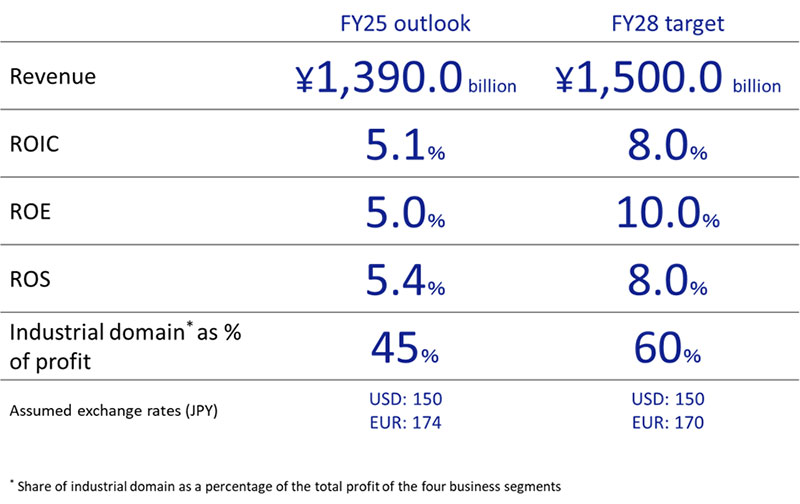
REFERENCE: New Business Segments
Epson has redefined its business segments based on its policy of focusing resources on growth domains.
The Precision Innovation segment will play the role of growth engine. The role of Industrial & Robotics will be to generate robust growth in Phase 2. The role of the Office & Home Printing segment and Visual & Lifestyle segment is to generate steady cash.
- Precision Innovation
Inkjet solutions business, microdevices business, Epson Atmix - Industrial & Robotics
Commercial & industrial printing business, robotics business - Office & Home Printing
Office and home IJP business - Visual & Lifestyle
Visual products business, wearable products business, PC business
Shareholder Returns
Proactively delivering shareholder returns while also investing in growth
Under the Phase 1 plan, Epson will actively invest capital in growth domains, which will also include strategic investments. At the same time, we will boost shareholder returns by setting a minimum dividend level at a 3% DOE and, together with flexible share buybacks, more proactively deliver shareholder returns.
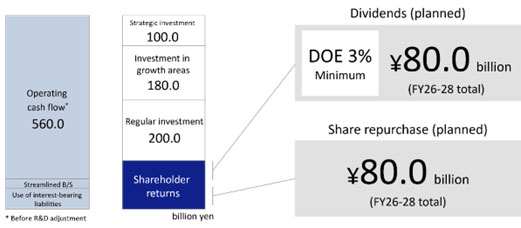
* For details about the ENGINEERED FUTURE 2035 Long-Term Corporate Vision and Mid-Term Business Plan, Phase 1, please see the investor information on Epson's website.
corporate.epson/en/investors/publications/presentations.html
Official Account